Unlock Consistently Better Results Through Thoughtful Technique, Material Awareness, and Practical Progression
Sanding is far more than rubbing abrasive against a surface—it’s the essential bridge between raw material and a finish that lasts. When approached with intention, sanding transforms rough wood into a receptive canvas, prepares metal for durable coatings, and smooths drywall seams into invisibility. Yet many projects encounter setbacks not from poor design, but from overlooked fundamentals: mismatched grit sequences, inconsistent directional awareness, or rushed progressions that leave scratches visible only after the finish is applied. This comprehensive guide offers a clear, adaptable framework grounded in material behavior and practical workflow. Whether you’re refinishing a family heirloom, prepping walls for paint, or smoothing metal for restoration, you’ll gain reliable strategies to work efficiently, avoid common pitfalls, and achieve surfaces worthy of your effort.
Introduction: Sanding as Purposeful Preparation
Run your hand across a beautifully finished table or a seamlessly painted wall. What you feel isn’t just the topcoat—it’s the cumulative effect of every preparatory step beneath it. Sanding shapes how finishes adhere, how light interacts with the surface, and how long the result remains pleasing. A skipped grit stage may leave scratches that emerge under varnish. Sanding against the grain on softwood can raise fibers that reappear after staining. Rushing coarse stages often creates deeper flaws requiring significant correction later.
While exact failure rates vary across contexts, professionals across woodworking, automotive, and construction consistently emphasize surface preparation as foundational to lasting results. Yet sanding is often surrounded by oversimplified advice: “Sand until it feels smooth,” “Use whatever grit is handy,” or “More pressure speeds things up.” These shortcuts overlook how materials respond uniquely to abrasion. Mastery emerges not from force, but from understanding—recognizing that sanding is a dialogue with the material, not a battle against it.
This guide synthesizes widely accepted practices from finishing traditions, material science principles, and hands-on workshop experience. It reframes sanding as a deliberate, layered process where each choice informs the next. You’ll learn why progression matters more than pressure, how grain direction guides motion, and why adapting technique to your specific material prevents frustration. This isn’t about perfectionism—it’s about working smarter. Thoughtful sanding saves time, reduces material waste, and builds confidence for every project that follows.
The Sanding Success Framework: Three Interlocking Layers
True consistency comes from a repeatable system—not random steps. After reviewing common project workflows and established finishing resources, we’ve structured sanding excellence into three interconnected layers. These layers build upon one another; weakening one affects the whole process. This framework applies across materials and project scales because it focuses on universal principles: assess first, progress deliberately, and align with the material’s nature.
Layer 1: Material Assessment – Diagnose Before You Abrade
Sanding begins with observation. What are you working with? This question shapes every subsequent decision. Consider these practical checkpoints:
-
Material Type: Solid wood (hardwood vs. softwood), engineered wood (plywood, MDF), metal (steel, aluminum), drywall, plastic, or a previously coated surface? Each responds differently. Pine’s resin pockets may gum up paper; MDF dust requires careful handling; aluminum smears without lubrication; drywall paper tears if sanded too aggressively near seams.
-
Surface Condition: Mentally rate the starting point:
Rough = Deep scratches, mill marks, heavy oxidation
Moderate = Visible imperfections, prior sanding marks
Refined = Nearly smooth, minor nibs or dust spots
This assessment guides your starting grit and tool choice. A rough surface needs aggressive removal; a refined surface only requires light de-nibbing. -
Grain or Structure (for wood): Gently run fingertips across the surface. Does it feel smoother in one direction? That’s your guide. Hardwoods like oak show pronounced grain; softwoods like pine have uneven density between growth rings. On figured wood or end grain, direction may shift—observe closely.
-
Existing Coatings: Paint? Varnish? Test a hidden area with mineral spirits. If it softens, it’s likely oil-based. Critical safety note: Assume pre-1978 paint contains lead. Do not sand without verified safety protocols and professional guidance. When uncertain about coatings or materials, consult a specialist.
Why this layer matters: Sanding without assessment risks damage. Using coarse grit on a veneered surface may sand through the thin layer. Aggressive tools on delicate finishes can remove irreplaceable character. Taking 60 seconds to observe prevents hours of repair.
Practical adaptation: No two pieces of wood are identical. Maple (dense, closed-grain) tolerates firmer pressure than walnut (softer, open-grain). When trying a new material, test your approach on scrap or an inconspicuous area first. Document what works for future reference.
Layer 2: Grit Strategy – The Progressive Scratch Replacement Protocol
Grit selection is often misunderstood. The goal isn’t merely “coarse to fine”—it’s systematic scratch replacement. Each grit leaves microscopic scratches; the next finer grit’s sole purpose is to remove those specific scratches. Skip too far, and deeper scratches remain, potentially visible after finishing.
Visualize it: Coarse grit (60) creates deep channels. Medium grit (120) replaces them with shallower grooves. Fine grit (220) leaves faint lines. Ultra-fine (400+) polishes to near-invisibility. Jumping from 60 to 220 leaves the deep 60-grit channels untouched—220-grit particles are too fine to cut their walls effectively.
The Practical Grit Progression Guideline
For most woodworking and general surfaces:
Advance no more than one standard increment at a time.
Common sequence (CAMI standard, North America):
40 → 60 → 80 → 100 → 120 → 150 → 180 → 220 → 320 → 400+
How to apply this:
– Starting at 80? Next step: 100 or 120 (not 150+).
– Starting at 120? Next: 150 or 180.
– Final prep before stain on bare wood: Typically 180 or 220.
– Between finish coats: 320 or 400.
Contextual exceptions:
– Heavy removal (e.g., stripping old finish): Start at 60, move to 80, then 100. Verify scratches are uniform before advancing.
– Metal or automotive clear coat polishing: Microscopic scratches allow larger jumps (e.g., 1500 to 3000) when leveling orange peel, not removing deep scratches.
– Drywall: Often progresses 120 → 150 → 220. Coarser grits risk tearing paper facing.
Navigating Grit Numbering Systems: CAMI vs. FEPA
Confusion arises from regional standards. Mismatched systems disrupt progression.
| System | Common Region | Label Clue | Practical Note | Example Equivalence |
|---|---|---|---|---|
| CAMI | North America | No prefix (e.g., “120”) | Slightly coarser at same number | CAMI 120 ≈ FEPA P100 |
| FEPA | Europe/Global | “P” prefix (e.g., “P120”) | More precise micron grading | FEPA P120 ≈ CAMI 150 |
| JIS | Japan | “J” prefix | Finer than CAMI at same number | JIS 400 ≈ CAMI 600 |
Key implication: If your sander pads are labeled “P180” (FEPA) but your sheets say “180” (CAMI), you’re effectively skipping a grit stage. For consistency within a project, match systems. When purchasing supplies, check packaging notes (“Meets FEPA P-standard” or “CAMI graded”). For critical work, micron size (particle diameter in micrometers) offers brand-independent clarity—reputable suppliers often list this.
Grit Selection Reference Guide: Purpose and Material Context
Use this as a quick decision aid. Adapt based on your specific project needs.
| Grit Range | Typical Uses | Recommended Starting Points | Important Considerations |
|---|---|---|---|
| Extra Coarse (24–40) | Heavy stock removal, rust stripping | Rough-sawn lumber, cast iron restoration | Use sparingly. Avoid on veneers, finished surfaces, or thin materials. |
| Coarse (50–80) | Leveling deep scratches, removing mill glaze | New dimensional lumber, deck restoration | 80-grit is often the safest starting point for raw wood projects. |
| Medium (100–150) | General smoothing, scratch refinement | Solid wood furniture, cabinetry, drywall seams | 120-grit is a versatile “workhorse” grit for initial smoothing. |
| Fine (180–240) | Final prep before stain/oil; between coats | Bare wood, primed surfaces | Stop at 180 for softwoods before stain; 220 is common for hardwoods. |
| Very Fine (320–600) | Smoothing between finish coats; metal prep | Sealed wood, automotive primer | Light pressure only. Over-sanding can burnish wood, affecting stain absorption. |
| Ultra Fine (800+) | Polishing clear coats, high-gloss metals | Automotive clear coat, lacquered surfaces | Typically used wet. Never dry-sand automotive clear coat below 1500 grit. |
Why micron awareness helps: Grit numbers represent ranges. CAMI 220 may vary between 52–63 microns. For museum restoration or automotive work where consistency is critical, specifying micron size (e.g., “50-micron paper”) ensures uniformity across brands.
Adapting to constraints:
– Budget-conscious path: Purchase multi-grit packs (80/120/220). Progress sequentially. Accept slightly longer sanding time per stage.
– Efficiency-focused path: Invest in premium ceramic or zirconia alumina paper (e.g., brands like Mirka Iridium, Norton 3X). These resist clogging, cut faster, and maintain sharpness longer—reducing total effort.
– Limited supplies: Only have 100 and 320 grit? Sand thoroughly with 100 until scratches are uniform and consistent. Then use 320 with very light pressure, frequent paper changes, and extra time. Inspect carefully under light before proceeding. Not ideal, but workable in a pinch.
Layer 3: Direction Awareness – Aligning Motion with Material Structure
Direction isn’t preference—it’s physics. Materials have inherent structure. Wood fibers run in lanes. Metal has crystalline grain. Drywall compound shrinks along seam lines. Sanding with these pathways shears cleanly. Sanding against them risks tearing, smearing, or uneven wear. This layer transforms sanding from random motion to intentional action.
Wood Grain Direction: Practical Identification
Always sand with the grain where possible. But grain isn’t always obvious—especially on curved pieces, end grain, or figured wood. Use these field-tested methods:
- Fingernail Test: Lightly drag a fingernail across the surface in different directions. The direction where it glides smoothly (minimal catch) is with the grain.
- Light Test: Shine a bright flashlight sideways across the surface. Shadows reveal the subtle ridges of grain direction.
- Water Test (raw wood only): Dab a tiny drop of water on an inconspicuous spot. Fibers swell along the grain direction first, making it visible within seconds. Blot dry immediately after observing.
Why it matters: Sanding against the grain on pine often creates “fuzz”—raised fibers that feel smooth initially but reappear rough after finishing. On oak, cross-grain sanding leaves scratches that absorb stain darker, creating permanent grid patterns. With-grain sanding slices fibers cleanly at the surface.
Adapting to complexity: On table legs, carvings, or rounded edges, grain direction shifts. Sand locally with the grain in each section. For curves, use small oval motions that follow the contour—not straight lines that dig in at endpoints. Patience here prevents flat spots or torn fibers.
Directional Guidance for Other Materials
- Drywall: Sand seams parallel to the joint tape direction. Perpendicular motion risks lifting tape edges. For large areas, use wide, overlapping oval motions with a pole sander to avoid flat spots.
- Metal: Sand in one consistent direction (often vertical on panels). Random patterns can trap moisture or show through paint. For final polishing stages, circular motions may blend marks—but maintain directional consistency through grit progression.
- Plastics/Composites: Sand with visible mold flow lines (faint streaks). Against-flow sanding risks micro-fractures. Use light pressure and lubrication (soapy water) to prevent melting.
- Between Finish Coats: Always sand with the wood grain, even on sealed surfaces. Cross-grain motion creates micro-grooves that trap finish, causing uneven sheen.
Core Insight: Sanding direction is defined by the material’s structure—not the tool’s motion. Align your action with that structure. When you work with the material, effort decreases and results improve.
Tool Selection: Matching Method to Project Needs
The right tool amplifies good technique; the wrong tool magnifies errors. Choose based on surface geometry, material, and your goals—not just what’s available.
Hand Sanding: Precision for Critical Areas
Best for: Final smoothing before stain, edges, corners, carvings, antique restoration, or areas where power tools risk damage.
Effective execution:
– Always use a block—never bare-handed. A rigid block (hardwood, cork) ensures even pressure on flat surfaces. A flexible rubber block conforms to curves.
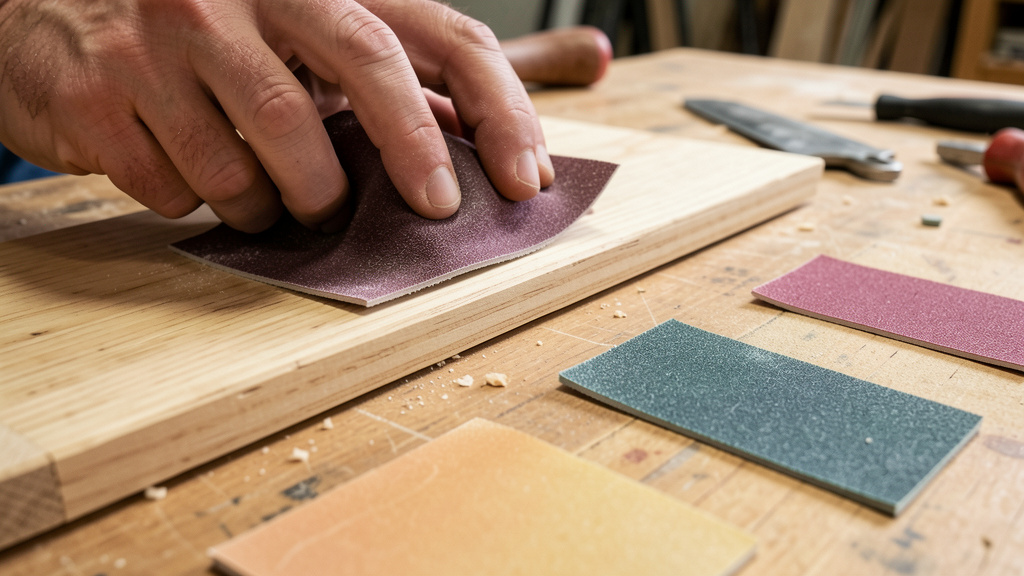
– Fold paper efficiently: Tear a sheet into quarters. Fold one quarter into a small pad (three folds creates eight usable edges). This maintains sharp abrasive edges and fits block contours.
– Motion technique: Short, controlled strokes with the grain. Lift the block at the end of each stroke—avoid back-and-forth sliding, which creates swirls.
– Pressure guide: Use just enough pressure to maintain contact. Imagine holding a ripe tomato—contact without bruising. Excessive pressure heats the paper, clogs pores faster, and fatigues your hand.
Adaptive tip: For final de-nibbing (removing raised fibers after water popping), wrap 320-grit paper around a soft foam block. The foam conforms to micro-irregularities without digging in.
Random Orbital Sanders (ROS): Versatile Workhorses
Why ROS stands out: The pad moves in tiny ellipses while rotating. This random pattern minimizes visible swirl marks, making it suitable for most flat or gently curved surfaces. Look for 5″ or 6″ pad size, variable speed (8,000–12,000 OPM), and hook-and-loop paper attachment.
Effective ROS protocol:
1. Start at lower speed for coarse grits (60–100) to control cutting.
2. Increase speed for medium/fine grits (120–220) for efficient scratch removal.
3. Hold with both hands: dominant hand on top, support hand on front.
4. Let the tool’s weight do the work—apply minimal downward pressure.
5. Move slowly (approx. 6 inches per second) in overlapping passes.
6. After each pass, wipe with a tack cloth and inspect under raking light.
Critical habit to build: Never lift the sander while it’s running (“hovering”). Place it on the surface before triggering, and release the trigger before lifting. Hovering causes the pad to spin freely, embedding deep circular scratches that are difficult to remove.
Note on other tools:
– Standard orbital (finish) sanders (non-random motion) are prone to swirl marks and are largely superseded by ROS for final smoothing.
– Belt sanders remove material aggressively but carry high risk of gouging. Only use for removing >1/16″ of material on large, flat surfaces—and only with experience. Always sand with the grain, keep moving, and tilt slightly on edges. Not recommended for beginners.
Detail Sanders and Specialty Tools
Triangular “mouse” sanders access tight corners but can leave vibration patterns. Best practice: Use only for initial shaping with coarse grits (80–100), then switch to hand sanding with a custom block for final smoothing. For deep corners, glue sandpaper to a tongue depressor or plastic scraper handle.
Drum/wide belt sanders: Designed for floors or large panels. Require significant skill to avoid waves or uneven surfaces. DIYers should seek training or professional assistance for floor sanding.
Tool Selection Decision Flow
Ask these questions before starting:
1. Is the surface flat and larger than 1 sq. ft.? → Random Orbital Sander (with appropriate grit progression).
2. Are there tight corners, carvings, or delicate edges? → Hand sanding with custom-shaped blocks.
3. Do I need to remove significant material (>1/8″)? → Re-evaluate necessity; if essential, use belt sander with extreme caution or seek professional help.
4. Is it metal, plastic, or automotive? → ROS with material-specific abrasives (often with lubrication); verify compatibility first.
Material-Specific Guidance: Adapting Technique to Substrate
Generic advice fails when materials demand specificity. Apply these context-aware protocols.
Wood Varieties
Hardwoods (Oak, Maple, Cherry, Walnut):
– Starting grit: 100–120 for surfaced lumber; 80 only for rough-sawn.
– Progression: 120 → 150 → 180 (typical pre-stain). For water-based finishes or ultra-smooth oil finishes, progress to 220.
– Helpful nuance: Open-grain woods (oak, ash) benefit from “grain raising”: After final sanding to 180, lightly dampen with distilled water. Let dry completely (1–2 hours). Sand very lightly with 220 to remove raised fibers. Prevents post-finish “fuzz.”
– Consideration: Avoid sanding raw hardwood beyond 220 before stain. Over-sanding can burnish the surface, closing pores and potentially causing uneven stain absorption—especially on maple or cherry.
Softwoods (Pine, Cedar, Fir):
– Starting grit: 120 (avoid coarser than 100 unless removing deep damage).
– Progression: 120 → 150 → 180 (typically stop here before stain).
– Helpful nuance: Softwoods have uneven density between growth rings. Aggressive sanding with coarse grits can create “dish-out” (valleys in softer areas). Use lighter pressure and progress gradually. A pre-stain conditioner (applied after sanding) can minimize blotchiness on pine.
– Consideration: Follow the dominant grain direction even if growth rings curve. Sanding across rings increases tear-out risk.
Engineered Wood (Plywood, MDF, Particleboard):
– Plywood: Sand only the face veneer. Start at 120. Progress to 150 or 180. Never use grits coarser than 100—risk of sanding through veneer. Edges are end-grain; sand carefully and consider sealing before assembly.
– MDF: Highly abrasive on sandpaper. Start at 120. Progress to 150 → 180. Use paper with anti-clog coating (stearated). Sand lightly—MDF dust is hazardous; wear a N95/P100 respirator and use dust extraction. Final surface must feel uniformly smooth; scratches show clearly under paint.
– Particleboard: Similar to MDF but more fragile near edges. Lightly seal raw edges with diluted wood glue (50/50 with water) before sanding to harden the surface.
Metal Surfaces
Ferrous Metals (Steel, Iron):
– Goal: Remove rust, create texture for paint adhesion, avoid heat buildup.
– Process: For heavy rust, start with 80-grit flap disc on angle grinder (with safety gear). Progress to 120 → 180 on ROS. Final prep before primer: 220.
– Important: Sand in one consistent direction (e.g., vertical strokes). Wipe with mineral spirits after sanding to remove embedded particles that could cause flash rust.
– Consideration: Standard aluminum oxide paper loads (clogs) quickly on steel. Zirconia alumina or ceramic abrasives designed for metal perform better.
Non-Ferrous Metals (Aluminum, Brass, Copper):
– Goal: Avoid smearing, achieve uniform scratch pattern.
– Process: Start at 120 with lubrication (soapy water or metal-specific lubricant). Progress 180 → 220 → 320. For polishing, continue wet-sanding to 600+.
– Critical practice: Sand wet beyond 180 grit. Dry sanding generates heat that smears metal. Use silicon carbide wet/dry paper. Change water frequently.
– Avoid: Steel wool or wire brushes on aluminum—they embed iron particles that accelerate corrosion.
Drywall and Plaster
- Starting grit: 120 for initial seam leveling.
- Progression: 150 → 220 for final smoothing. Never use grits coarser than 100—rips paper facing.
- Technique: Use a 12″ drywall sanding pole with mesh screen (not paper). Sand parallel to seams. Feather edges outward 12+ inches. Check progress with a bright work light held sideways—shadows reveal imperfections.
- Proven refinement: Sand after primer (“prime-sand-prime”). Primer seals dust and highlights flaws invisible to the naked eye. Lightly sand high spots with 220-grit screen, then re-prime. This cycle significantly improves final appearance.
- If you sand through paper: Stop immediately. Apply joint compound, let dry completely, and restart progression from 120 grit.
Plastics and Composites (Fiberglass, Carbon Fiber)
- Starting grit: 180 for smoothing mold lines.
- Progression: 220 → 320 → 400 (wet).
- Critical practice: Sand wet with silicon carbide paper. Dry sanding generates heat that melts plastic, clogs paper, and creates static. Use soapy water as lubricant.
- Consideration: Use hand sanding or ROS at lowest speed. Plastics scratch easily; patience prevents deep gouges. For automotive bumpers, consult manufacturer repair guidelines—some require adhesion promoters after sanding.
Previously Painted or Finished Surfaces
- Goal: De-gloss for recoating adhesion, not strip all paint.
- Process: Lightly sand entire surface with 180–220 grit. Focus on glossy areas. Wipe thoroughly with a TSP (trisodium phosphate) solution or appropriate cleaner to remove dust and grease.
- Adhesion check: Press duct tape firmly on surface, rip off quickly. If paint lifts significantly, sanding alone won’t ensure adhesion—complete stripping may be necessary.
- Critical safety note: Assume paint in pre-1978 structures contains lead. Do not sand without verified safety protocols (HEPA vacuum, respirator, containment) and professional guidance. When in doubt, consult a specialist.
Diagnosing and Correcting Common Sanding Challenges
Mistakes happen. The path to confidence lies in systematic correction. Here’s how to address frequent issues.
Challenge 1: Swirl Marks (Circular Scratches)
Likely causes: Worn sandpaper, lifting sander while running (“hovering”), moving too quickly with ROS, or using a non-random orbital sander for final smoothing.
Correction steps:
1. Identify affected areas under raking light.
2. Drop back two grits below your last grit (e.g., if last was 220, use 150).
3. Sand with the grain using ROS at medium speed. Focus only on affected zones with light, overlapping passes.
4. Progress normally: 150 → 180 → 220.
5. Verify under light before proceeding.
Prevention: Change paper regularly (every 15–20 minutes of active use). Never hover the sander. Use ROS for final smoothing stages.
Challenge 2: Cross-Grain Scratches
Identification: Straight scratches perpendicular to wood grain. Often appear darker after staining.
Correction steps:
1. Assess scratch depth. For light scratches: proceed to step 2. For deep scratches: fill with appropriate wood filler, let dry completely, sand flush.
2. Sand with the grain using grit one step coarser than your last grit (e.g., if last was 180, use 150). This shears off cross-grain peaks.
3. Progress normally: 150 → 180 → 220.
4. For persistent scratches, a cabinet scraper (used with the grain) after 150-grit sanding can cleanly remove fibers without cross-abrasion.
Prevention: Confirm grain direction with the fingernail test before starting. Sand edges with a folded paper block moving along the edge’s grain direction.
Challenge 3: Uneven Surfaces (“Washboarding” or Dishing)
Identification: Wavy texture visible under raking light.
Common causes: Dwelling in one spot with belt sander, using flexible block on flat surface, or excessive pressure with ROS.
Correction steps:
1. For mild waviness: Sand entire surface with coarse grit (80–100) using a rigid sanding block or ROS with firm backing pad. Focus on high spots identified by light test.
2. Progress slowly through grits, checking flatness after each stage.
3. For severe dishing: Sanding alone may not suffice. Consider professional milling or accept as character if minor.
Prevention: Use rigid blocks for flat surfaces. Let tool weight do the work—avoid downward pressure. Move sander continuously.
Challenge 4: Burnishing (Overly Smooth, Sealed Surface)
Identification: Wood feels unnaturally slick; stain beads up or absorbs unevenly.
Common causes: Sanding too fine before stain (e.g., 320+ on raw wood), excessive pressure generating heat, or using worn paper that polishes instead of cuts.
Correction steps:
1. Lightly sand entire surface with 150-grit paper with the grain. Goal is to reopen pores, not remove material.
2. Wipe with tack cloth.
3. Proceed to 180 or 220 as appropriate for wood type.
4. Test stain absorption on scrap first.
Prevention: For raw wood before stain, typically stop at 180–220 grit. Change paper before it feels “slick.” Use light, consistent pressure.
Challenge 5: Sanding Through Veneer or Edges
Identification: Thin wood layer worn away, revealing substrate; edges feel sharp or thin.
Correction considerations:
– Veneer: If substrate is visible, repair options are limited. Lightly tint with wood dye to blend, seal, and finish (camouflage only). For valuable pieces, consult a professional restorer.
– Edges: Sand adjacent areas to feather the transition. Apply matching edge banding or tinted wood filler. Seal before final finish.
Prevention: Know your material thickness. Use 150+ grit on veneers. Hand-sand edges with very light pressure. Always test approach on scrap first.
Challenge 6: Clogged Sandpaper (“Loading”)
Identification: Paper feels smooth, stops cutting efficiently, leaves smeared residue. Common on resinous woods (pine), MDF, or plastics.
Immediate action: Replace paper. Cleaning rarely restores full cutting ability.
Prevention strategies:
– Use “open-coat” paper (more space between grits) for soft/resinous materials.
– Choose stearated (anti-clog) paper.
– Apply lighter pressure.
– Ensure dust extraction is active on power sanders.
– For hand sanding, lightly rub paper on concrete edge to “refresh” grit (temporary fix only).
Advanced Techniques for Refined Results
Wet Sanding: Purpose and Protocol
When to use: Reducing heat/dust, achieving ultra-smooth finishes, preventing clogging on sticky materials. Essential for automotive clear coats, aluminum, brass, plastics, and final stages of high-gloss wood finishes.
Protocol:
1. Use silicon carbide “wet/dry” paper (black backing).
2. Soak paper in water with a few drops of dish soap for 5+ minutes before use.
3. Keep surface and paper wet during sanding. Re-wet frequently.
4. Progress through grits while wet (e.g., 400 → 600 → 1000).
5. Rinse surface and paper often to remove slurry.
6. Dry thoroughly before next step.
Critical note: Never wet-sand raw, unfinished wood—it permanently raises grain. Reserve for sealed surfaces or non-porous materials.
Sanding Between Finish Coats
Why it matters: Each coat raises wood fibers and traps dust nibs. Light sanding creates “tooth” for adhesion and eliminates imperfections.
Protocol:
1. Wait until finish is fully dry per manufacturer’s instructions (often 24+ hours).
2. Use 320 or 400-grit stearated paper.
3. Sand very lightly with the grain—goal is to dull sheen, not remove finish.
4. Wipe meticulously with tack cloth, then microfiber cloth dampened with mineral spirits.
5. Inspect under bright light before recoating.
Note: Water-based finishes raise grain more significantly than oil-based—sanding between coats is especially important.
The Water Pop Technique (Grain Raising)
Purpose: Minimize post-stain “fuzz” on raw wood.
Steps:
1. After final sanding (e.g., 180 grit), lightly dampen entire surface with distilled water using a clean cloth. Avoid puddles.
2. Let dry completely (2–4 hours, depending on humidity). Fibers will raise uniformly.
3. Sand very lightly with 220-grit paper to remove raised fibers.
4. Proceed with staining.
Best for: Softwoods and open-grain hardwoods. Test on scrap first. Skip if using a pre-stain conditioner per product instructions.
Custom Sanding Blocks for Complex Shapes
Why: Factory blocks can’t conform to curves, carvings, or tight radii.
Simple method:
1. Cut scrap wood, cork, or dense foam to match the contour needing attention.
2. Securely attach sandpaper (spray adhesive works well).
3. For convex curves: Wrap paper around a dowel or PVC pipe section.
4. For concave curves: Carve a block from balsa wood or shape modeling clay wrapped in paper.
Application example: Restoring a turned chair leg—create a block matching the leg’s curve for consistent pressure and even results.
Dust Management: Health and Clarity
Sanding dust hazards: Wood dust (respiratory irritant), MDF dust (contains formaldehyde binders), metal dust (toxic).
Essential practices:
– Wear a properly fitted N95 or P100 respirator—standard dust masks are insufficient.
– Use tools with integrated dust ports connected to a shop vacuum (HEPA filter preferred).
– Work in a well-ventilated area.
– Wipe surfaces with tack cloth before and after sanding.
– Clean workspace with a damp cloth—dry sweeping aerosolizes dust.
Practical insight: Effective dust extraction isn’t just about safety—it maintains paper cutting efficiency. Clogged pores reduce performance. Clean paper cuts faster and more evenly.
Your Questions, Answered
Q: Can I skip grits to save time? For example, go straight from 80 to 180?
A: Skipping more than one standard grit increment risks leaving deep scratches that finer grits cannot effectively remove. While exact time savings vary, proper progression (80→120→150→180) typically proves more efficient overall. Skipping stages often requires significantly longer sanding at the finer grit to correct remaining scratches, with higher risk of uneven results. The perceived time saving is usually offset by correction work later.
Q: How do I know when I’ve sanded enough with a particular grit?
A: Use three verification steps: 1) Run fingertips lightly across the surface—no snags or rough patches. 2) Wipe with tack cloth, then inspect under bright raking light (flashlight held sideways). Scratches should appear uniform in depth and direction. 3) For bare wood, dampen a small hidden area with mineral spirits—it temporarily darkens the wood, revealing hidden scratches. If scratches remain visible after drying, continue sanding with that grit.
Q: Is higher grit always better for a smoother finish?
A: Not necessarily—context determines the appropriate grit. For raw wood before stain, sanding beyond 220 (e.g., to 400) can burnish the surface, closing pores and potentially causing uneven stain absorption. Higher grits are reserved for specific purposes: between finish coats (320–400), final polish on sealed surfaces (600+), or non-porous materials like metal and plastic. Always match the grit to the next step in your process.
Q: Why does my sandpaper clog so quickly on pine or MDF?
A: Resinous woods (like pine) and composite materials (like MDF) contain sticky binders or sap that gum up abrasive particles. Solutions include: using “open-coat” sandpaper (more space between grits), stearated (anti-clog) paper, applying lighter pressure, ensuring dust extraction is active on power sanders, or lightly sanding pine when slightly damp (test first—never wet). For MDF, frequent paper changes and robust dust collection are essential.
Q: Can I sand pressure-treated lumber?
A: Yes, with precautions. Wait until the wood is fully dry (which may take weeks after installation—surface should not feel damp). Wear a P100 respirator; chemicals in treated wood create hazardous dust. Start at 80-grit to remove mill glaze, progress to 120. Never sand near living areas, gardens, or water sources. Dispose of dust per local regulations. Alternatively, allow weathering to naturally smooth the surface over time before finishing.
Q: How do I sand rounded edges without creating flat spots?
A: Use a flexible sanding block (rubber or foam) that conforms to the curve. Sand in small oval motions that follow the edge contour—not straight back-and-forth strokes. For hand sanding, wrap paper around your fingers but maintain consistent, light pressure. Check frequently by sight or touch to ensure the radius remains uniform. Power sanders require extra caution here; hand sanding is generally preferred for critical edges.
Q: Is sanding direction less important on end grain?
A: Actually, direction is more critical on end grain. End grain resembles a bundle of straws; sanding against the natural fiber direction frays fibers severely. Always sand end grain in the direction the wood would naturally grow (e.g., on a table leg end, sand toward the foot). Use progressively finer grits (start 100, end 220) and consider sealing end grain first with diluted glue (50/50 with water) to harden the surface before final sanding.
Q: What’s the difference between “grit” and “micron”? Which should I use?
A: Grit is a standardized numbering system (CAMI/FEPA) representing a range of particle sizes. Micron measures the exact average particle diameter in micrometers (µm). Example: CAMI 220 corresponds roughly to 52–63 microns. For most DIY projects, grit numbers are sufficient. For critical applications (automotive, fine restoration), specifying micron size ensures consistency across brands. Reputable abrasive suppliers often list both on packaging.
Q: Can I reuse sandpaper?
A: Lightly used paper (e.g., 5 minutes on ROS at fine grit) can be reused for the same grit stage on the same project if stored flat. However, once paper feels smooth, stops cutting efficiently, or shows visible wear patterns, replace it. Reusing heavily loaded paper wastes time and risks poor results. For hand sanding blocks, storing used paper in labeled containers can extend usability within a single session.
Q: How do I sand veneer without sanding through it?
A: Extreme caution is required. Start no coarser than 150-grit. Prefer hand sanding with a rigid block and very light pressure. Sand only until the surface is uniformly dull—not until “smooth.” Test your approach on scrap veneer first. For light cleaning or de-glossing, consider using mineral spirits and fine steel wool (0000 grade) instead of sanding. When working on valuable or antique veneered pieces, consulting a professional restorer is often the wisest choice.
Conclusion and Your Next Step
Sanding mastery grows through mindful repetition, not rushed effort. You now have a adaptable framework: assess your material carefully, progress through grits deliberately, and align your motion with the material’s structure. Remember three guiding principles that support consistent results:
1. Progression over pressure—systematic grit replacement achieves smoother results with less effort than aggressive grinding.
2. Awareness over speed—observing grain direction and surface response prevents damage that’s difficult to reverse.
3. Verification over assumption—inspect under raking light after each grit stage. What looks smooth head-on may reveal scratches from the side.
These practices transform sanding from a chore into a purposeful phase of creation—a quiet commitment to building a foundation worthy of the finish. The care you invest here echoes in every subsequent step.
The 24-Hour Verification Step
Before applying stain, paint, or final finish, incorporate this simple but powerful habit:
1. Complete all sanding and cleanup.
2. Wipe the surface meticulously with a tack cloth.
3. Step away. Do not proceed that day.
4. Return after 24 hours. In fresh light, inspect the surface again.
Why it works: Distance resets your perception. Minor scratches, dust nibs, or uneven spots that were invisible during focused work often become clear after a break. This pause prevents the frustration of discovering flaws after finish is applied—a mistake that can require stripping everything back to bare material. This practice reflects thoughtful craftsmanship.
The Broader Perspective: Sanding as Care
Every scratch you thoughtfully remove, every fiber you align with intention, every imperfection you address is an act of respect—for the material’s origin, for the craft’s traditions, and for the person who will use or enjoy the finished piece. In a culture of haste, choosing thorough preparation is a meaningful choice. It says: This project matters. The process matters. The result matters. Carry that intention into your workspace. Let sanding be not the step you rush through, but the foundation you build with care and confidence.
Explore Our Complete System:
The Thoughtful Guide to Wood Staining: Techniques for Even Color and Depth | Drywall Repair from Patch to Perfect: A Step-by-Step Companion | Metal Surface Preparation: From Rust Removal to Durable Coatings | The Finisher’s Handbook: Choosing and Applying Oils, Varnishes, and Paints | Workshop Wellness: Practical Dust Control and Respiratory Safety | Joinery Fundamentals: Creating Strong, Beautiful Wood Connections | Building Your First Workshop: Tool Selection and Space Planning for Lasting Success