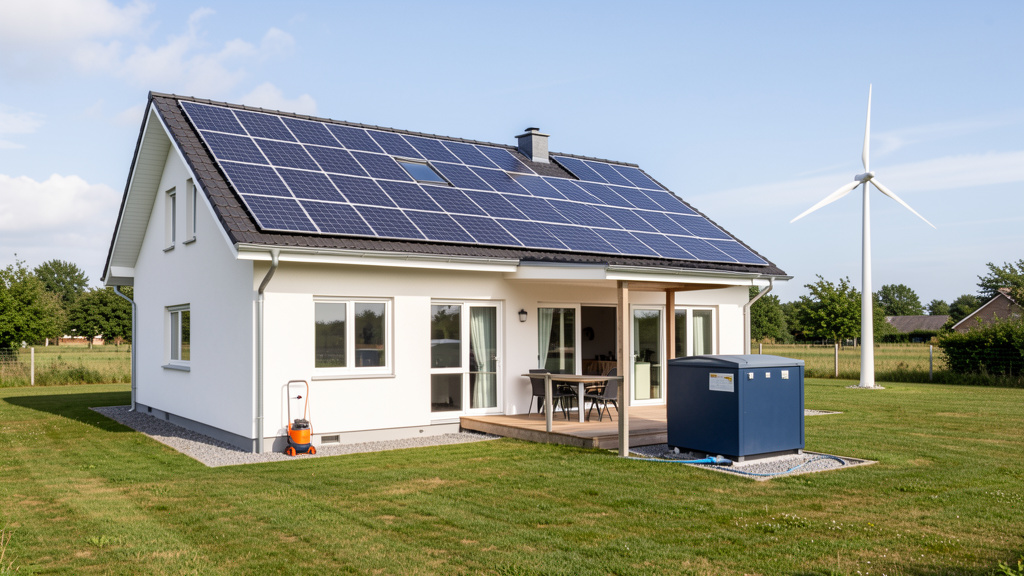
Build resilient, tailored energy security for your home—grounded in your reality, not hype. This guide transforms complexity into clarity through actionable steps, contextual choices, and realistic expectations.
Imagine maintaining essential power during a neighborhood outage: your refrigerator hums steadily, critical lights glow softly, and your family remains safe while others scramble. Energy independence isn’t isolation—it’s intelligent resilience. This guide replaces overwhelm with a structured, adaptable pathway. We navigate solar potential, wind viability, storage strategy, and system integration with nuance, empowering you to design a solution aligned with your property, budget, constraints, and vision. No fear-mongering, no universal promises—just grounded, actionable wisdom for building reliable energy security that evolves with your life.
Introduction
Energy independence has evolved from remote off-grid necessity to an accessible option for diverse households: suburban families seeking outage protection, rural property owners valuing self-sufficiency, environmentally conscious residents reducing carbon footprints, and those navigating rising utility costs. This shift stems from advancing technology accessibility, declining equipment costs, and heightened awareness of grid vulnerabilities during extreme weather events. Patterns observed across residential installations consistently indicate that systems designed through deliberate, phased planning demonstrate higher long-term satisfaction and performance compared to reactive implementations. True progress requires moving beyond simplistic “solar panel” solutions toward a holistic perspective where generation sources, storage capacity, consumption patterns, and local context interact as a unified ecosystem. Whether your primary motivation is financial prudence, emergency preparedness, environmental alignment, or layered resilience, the path demands clarity about your specific circumstances. This guide meets you wherever you are—sketching initial ideas or comparing installer proposals—and provides a structured framework to transform intention into tangible, adaptable results. Perfection isn’t the goal; building a foundation that grows smarter over time is.
The Resilient Energy Triad Framework: Assessment, Integration, Optimization
True energy resilience emerges not from a single technology purchase, but from the intentional sequencing of three interdependent pillars: Assessment, Integration, and Optimization. This framework synthesizes established engineering principles and documented patterns from residential renewable projects worldwide to replace complexity with sequential clarity. Each pillar addresses critical decision points often overlooked in fragmented resources, preventing common missteps while building informed confidence. Unlike approaches leading with equipment specifications, the Triad begins with your reality—energy patterns, property characteristics, financial parameters, and non-negotiable goals. Technology serves your life, not the reverse. Systems developed through this methodology consistently demonstrate greater adaptability to changing household needs, smoother implementation experiences, and sustained owner satisfaction. Importantly, “independence” exists on a spectrum—from reducing grid reliance by 70% with robust backup security to achieving full off-grid capability. This framework provides tools to define your meaningful target. Let’s walk through each pillar with the depth required for informed action.
Pillar 1: The Assessment Phase – Know Your Energy Landscape
Skipping thorough assessment is the most frequent precursor to system underperformance or misaligned expectations. This phase transforms vague intentions (“I want solar”) into precise, actionable data through accessible documentation—not engineering expertise.
Step 1: Audit Your Current Energy Consumption (The Non-Negotiable Foundation)
Before sizing any system, understand your baseline demand. Guessing risks dangerous mismatches: undersized systems leave critical gaps during outages; oversized systems waste capital and may face interconnection constraints. Begin by gathering twelve months of utility bills. Note kilowatt-hour (kWh) usage per month—this reveals seasonal patterns invisible in annual averages. A household using 800 kWh in July (cooling peak) but only 400 kWh in January requires fundamentally different design than one with consistent year-round usage. Next, identify “critical loads”—essential circuits you must power during an outage. Is it refrigeration, medical equipment, sump pump, lighting, and Wi-Fi? Or does it include well pumps or workshop tools? List every device, its wattage (found on nameplate or manual), and estimated daily runtime. A refrigerator might draw 150 watts but cycle on for 8 hours daily (1,200 Wh); a sump pump may use 800 watts but run only 30 minutes daily (400 Wh). Sum these to determine critical load watt-hours per day. Tools simplify this: plug-in energy monitors (like Kill A Watt meters, under $30) provide exact measurements per appliance. For whole-home insight, many utilities offer free online portals with hourly usage data, or non-invasive clamp-on monitors (Sense, Emporia Vue) attach to your main electrical panel. Documented cases show homeowners discovering “always-on” phantom loads—entertainment centers, garage freezers, routers—consuming 15–20 kWh monthly. Addressing these before system design can reduce required battery capacity by 10–15%, saving significant upfront cost. Remember: reducing demand is consistently more cost-effective than generating additional power. This audit isn’t deprivation; it’s strategic awareness. Document everything in a simple spreadsheet. This data becomes your design compass.
Step 2: Evaluate Your Property’s Renewable Potential (Beyond “Sunny Enough”)
Solar viability depends on far more than regional climate. Conduct a detailed site survey focusing on three factors: solar access, wind resource, and physical constraints. For solar: use satellite tools like Google Project Sunroof or NREL’s PVWatts Calculator. Note shading sources—trees, chimneys, neighboring buildings—throughout the year. A deciduous tree bare in winter may cast dense shade in summer. Perform the “shadow observation” test: at solar noon on the summer solstice (June 21) and winter solstice (December 21), document shadow patterns on your roof. South-facing roofs (Northern Hemisphere) are ideal, but east/west orientations can be highly effective with modern panel technology. Measure available roof space: standard panels are ~65″ x 40″ (17.5 sq ft each). Account for fire code setbacks (typically 18″ pathways on roof edges). Ground-mount options exist for limited or shaded roofs but require land, foundations, and zoning approval. For wind: small-scale residential wind is frequently misunderstood. Turbines require consistent, unobstructed wind. Turbulence from buildings or trees drastically reduces output and accelerates wear. Reputable resources like the U.S. Department of Energy’s Small Wind Guidebook recommend sites with verified average annual wind speeds of at least 10 mph (4.5 m/s) for viability—many suburban areas fall below this. Use NREL wind maps or install a calibrated anemometer for 3–12 months to gather site-specific data. Crucially, check local zoning: many municipalities restrict tower heights (often requiring 30+ feet above obstructions) or prohibit turbines entirely in residential zones. Physical constraints matter deeply: roof age/condition (installing panels on a roof needing replacement in 5 years incurs future costs), soil composition for ground mounts or battery enclosures, proximity to the main electrical panel (long wire runs increase voltage drop), and future property plans (will that sapling become a shading oak?). Document findings with photos and sketches. This step prevents emotional decisions (“I love the idea of wind!”) from overriding physical reality. A property in coastal Maine with consistent 12+ mph winds and minimal obstructions may benefit from a small turbine complementing solar; the same turbine in a leafy Atlanta suburb would likely underperform and cause neighbor concerns.
Step 3: Define Your Energy Independence Goals (Clarity Prevents Costly Compromises)
“Energy independence” carries different meanings. Articulate specific, measurable objectives:
– Primary Driver? Financial ROI (lowest cost per kWh), outage resilience (hours/days of backup), environmental impact (maximizing renewable offset), or layered security?
– Grid Relationship? Grid-tied with net metering (selling excess power), grid-tied with battery backup (powering critical loads during outages), or fully off-grid?
– Critical Load Duration? During an outage, how many hours must your system sustain essentials? A medical device requiring 24/7 power demands different storage than lighting and communication for 12 hours.
– Future-Proofing? Will you add an electric vehicle (adding 25–40 kWh daily demand), expand your home, or install a heat pump within 5–10 years?
Write these goals down. Example: “Remain grid-tied for net metering benefits while achieving 48 hours of backup power for critical loads (refrigerator, medical device, lights, Wi-Fi) during outages. Target 90% annual energy offset from solar. Budget: $35,000 after incentives. Plan for EV charger installation within 3 years.” This specificity guides every subsequent decision. Documented instances show homeowners initially seeking “full independence” realizing their true need was 8–12 hour outage coverage for wildfire or storm season—focusing budget on appropriately sized storage rather than oversized generation, saving significant capital. Vague goals invite scope creep; precise goals create alignment and peace of mind.
Step 4: Understand Local Regulations and Incentives (The Hidden Project Timeline)
Regulatory landscapes vary dramatically by location. Ignoring this phase risks delays, denied permits, or forfeited financial benefits. Begin with your local building department: inquire about permit requirements, fees, required drawings (often needing engineering stamps), and inspection protocols. Simultaneously, contact your utility company:
– Interconnection Agreement: Required for grid-tied systems. Process duration varies (weeks to months). Ask about application fees, technical requirements (specific inverters, disconnects), and net metering policies.
– Net Metering Details: Is it 1:1 credit (1 kWh exported = 1 kWh credit)? Is there a cap on system size? Are credits rolled over monthly or annually? Some utilities offer “net billing” where exported power is valued below retail rate—critical for ROI calculations.
– Incentives: Federal tax credits (e.g., U.S. Residential Clean Energy Credit, currently 30% through 2032) require sufficient tax liability. State programs vary widely: California’s SGIP offers battery rebates; New York’s Megawatt Block provides declining incentives; many states have property tax exemptions. Local utilities may offer additional rebates. The Database of State Incentives for Renewables & Efficiency (DSIRE) is the definitive free resource—search by zip code.
– HOA Restrictions: While many states prohibit HOAs from banning solar via “solar access laws,” they may regulate placement, color, or visibility. Review covenants early.
Document every contact: name, title, date, key details. Create a timeline: “Permit application submitted by [date], utility interconnection filed by [date], anticipated inspection window.” This proactive approach prevents frustration of having equipment delivered but unable to install due to pending approvals. Analysis of installation records shows projects delayed by months often stem from unanticipated interconnection processes or zoning hurdles—early verification is project velocity.
Pillar 2: The Integration Phase – Selecting and Combining Technologies
With assessment complete, integration focuses on selecting components that work synergistically. Avoid optimizing individual parts in isolation; system strength lies in how components interact to serve your documented goals, site constraints, and budget.
Step 1: Solar Power Systems – Technology Selection Grounded in Context
Solar photovoltaic (PV) systems convert sunlight to electricity. While panels are visible, the entire ecosystem matters.
– Panel Technology: Monocrystalline panels (uniform dark color) offer highest efficiency (20–23%) and space efficiency—ideal for limited roof area. Polycrystalline (blue, fragmented appearance) are slightly less efficient (15–18%) but often more budget-friendly for properties with abundant unshaded space. Thin-film (flexible, lightweight) suits curved surfaces or weight-sensitive roofs but requires significantly more area. For most residential roofs, monocrystalline provides optimal long-term value. Look beyond wattage to temperature coefficient (how output drops as panels heat; lower is better) and degradation rate (annual power loss; reputable brands guarantee <0.5% per year).
– Inverter Selection – The System’s Brain: Inverters convert DC power from panels to AC power for your home. Three primary types:
– String Inverters: Cost-effective for simple, unshaded roofs. All panels wired in series; shading on one panel can reduce the whole string’s output. Modern versions often include module-level power electronics (MLPE) like power optimizers (e.g., SolarEdge) that mitigate shading losses per panel.
– Microinverters: One small inverter per panel (e.g., Enphase). Maximizes output in shaded or complex roofs, enables panel-level monitoring, and enhances safety (shuts down DC voltage at each panel during outages). Typically 10–20% more expensive but preferred for resilience-focused designs.
– Hybrid Inverters: Essential for battery integration. Manage power flow between panels, batteries, home loads, and grid. Critical for backup functionality.
– Mounting Systems: Roof mounts must match roofing material (asphalt shingle, metal, tile). Flashing and sealing details prevent leaks—ask installers about their waterproofing protocol. Ground mounts offer optimal tilt/orientation and easier maintenance but require land, concrete foundations, and may face zoning hurdles. Tracking mounts (single-axis following sun east-west) boost yield 25–35% but add cost, complexity, and maintenance needs—rarely cost-effective for residential scale.
– Real-World Sizing Example: A home with 900 kWh monthly usage (30 kWh/day) in Colorado (4.5 peak sun hours/day) needs roughly 6.7 kW of panels (30 kWh ÷ 4.5 sun hours). Accounting for system losses (wiring, inverter efficiency ~14%), target ~7.7 kW. Using 400W panels: 7,700W ÷ 400W = ~20 panels. Always size based on annual production goals, not just peak summer output. Tools like PVWatts provide location-specific estimates. Seasonal note: In northern latitudes, December production may be only 10–15% of July output—storage or grid connection remains essential for year-round reliability.
Step 2: Wind Power Systems – When Conditions Align (and When They Don’t)
Small wind electric systems (typically under 100 kW) can complement solar in specific scenarios but are frequently misapplied.
– Turbine Types: Horizontal-axis wind turbines (HAWTs—the classic “propeller” design) are most efficient for consistent wind directions. Vertical-axis wind turbines (VAWTs) handle turbulent, shifting winds better (common in urban areas) but are generally less efficient and noisier. For residential use, HAWTs dominate viable installations.
– Tower Height is Non-Negotiable: Wind speed increases dramatically with height. Power output scales with the cube of wind speed—a 50% speed increase yields over 300% more power. Minimum recommended height: 30 feet above the nearest obstruction within 300 feet. This often means 80–120 foot towers—visually prominent and requiring significant setbacks.
– Viability Checklist: Only proceed if all are true:
1. Average annual wind speed ≥ 10 mph (verified by local data or on-site measurement)
2. Zoning permits tower height and setbacks
3. Property has ≥ 1 acre of clear, unobstructed space
4. Local utility allows interconnection of small wind systems
5. Budget accommodates $15,000–$50,000+ for a meaningful system (1–10 kW)
– Hybrid Solar-Wind Reality: Solar and wind can be complementary (sunny days may be calm; windy days may be cloudy), but integration complexity increases cost. A small turbine (1–2 kW) might offset 10–20% of annual usage in ideal conditions but rarely justifies its cost versus adding more solar panels. Exception: remote off-grid sites with exceptional wind resources where fuel transport is prohibitively expensive. For most seeking resilience, investing in additional solar capacity and battery storage delivers greater reliability and simplicity. Documented cases show success in ridge-top or coastal properties with verified high wind resources; conversely, suburban installations without verified data often yield negligible output and neighbor concerns. Honesty about site suitability prevents wasted investment.
Step 3: Energy Storage Solutions – The Resilience Engine
Batteries transform intermittent generation into reliable, on-demand power—the cornerstone of outage protection.
– Battery Chemistry Comparison:
| Chemistry | Depth of Discharge (DoD) | Cycle Life (to 80% capacity) | Space/Weight | Safety | Best For |
|—|—|—|—|—|—|
| Lithium Iron Phosphate (LFP) | 80–90% | 3,000–7,000+ | Moderate | Excellent (thermally stable) | Most residential applications – safety, longevity, value |
| Lithium NMC | 80–90% | 2,000–4,000 | Compact | Good (requires robust BMS) | Space-constrained installs; higher energy density |
| Lead-Acid (Flooded) | 50% | 500–1,200 | Bulky/Heavy | Moderate (ventilation needed) | Budget off-grid; existing systems |
| Lead-Acid (AGM/Gel) | 50% | 800–1,500 | Moderate | Good (sealed) | Backup-only; infrequent cycling |
LFP has become the dominant choice for new residential installations due to exceptional cycle life, safety profile (resists thermal runaway), minimal maintenance, and declining lifetime cost. While upfront cost per kWh may slightly exceed NMC, its longevity delivers better value. Avoid lead-acid for daily-cycling resilience systems—they degrade rapidly if deeply discharged.
– Sizing Your Battery Bank: Calculate based on critical loads and desired backup duration. Example: Critical loads total 1,500 Wh per hour. For 24 hours of backup: 1,500 Wh × 24 = 36,000 Wh (36 kWh). Account for depth of discharge: LFP at 90% DoD requires 36 kWh ÷ 0.9 = 40 kWh usable capacity. Add inverter efficiency loss (~10%): 40 kWh ÷ 0.9 = ~44.4 kWh nameplate capacity. Crucially: Most grid outages last less than 12 hours (utility data indicates 80% resolve within 8 hours). Prioritize covering essential loads for realistic durations rather than “whole-house forever” scenarios that balloon costs.
– AC-Coupled vs. DC-Coupled Systems:
– AC-Coupled: Batteries connect to the home’s AC panel via a separate battery inverter/charger. Easier to add to existing solar systems. Slightly lower round-trip efficiency.
– DC-Coupled: Batteries connect directly to solar panels via a charge controller before the inverter. Higher efficiency (especially for new installations), simpler wiring. Requires compatible hybrid inverter.
For new builds or full system replacements, DC-coupled is often optimal. For adding storage to existing solar, AC-coupled is typically more practical.
– Placement and Safety: Batteries require a dry, temperature-controlled location (garage, utility room, dedicated enclosure). Extreme cold reduces capacity; extreme heat accelerates degradation. LFP tolerates wider temperature ranges but still benefits from climate moderation. Maintain clearance per manufacturer specs. Ensure installers follow National Electrical Code (NEC) Article 706 for energy storage systems—proper labeling, disconnects, and ventilation are non-negotiable for safety and inspector approval.
Step 4: Designing a Hybrid System – Synergy Over Silos
Integration shines when components enhance each other. A solar-plus-storage system forms the foundational resilience package for most homeowners. Wind integration requires careful justification (see Step 2). Key integration principles:
– Load Management: Pair your system with smart load controls. During an outage, automatically shed non-essential loads (pool pump, EV charging) to preserve battery for critical circuits. Devices like Span IO or Lumin Smart Panel enable circuit-level control via app.
– Generator Integration: For extended outages or high-demand scenarios (well pumps, electric heating), design a “generator-ready” system. Hybrid inverters can auto-start a propane/natural gas generator when batteries reach a low threshold, recharging batteries while powering heavy loads. This creates a truly resilient “tri-generation” system (solar + storage + generator) without manual intervention.
– Future Expansion Path: Design conduit runs and panel space for future additions. Leave spare breaker slots. Choose inverters with expansion capabilities. If planning an EV charger, ensure your main panel has capacity or budget for a subpanel upgrade.
– Monitoring and Control: Unified monitoring platforms (Enphase Enlighten, Tesla app, Solar-Log) provide real-time visibility into generation, consumption, battery state, and grid interaction. Alerts for performance drops enable proactive maintenance.
The Fundamental Principle: A resilient energy system is not about maximizing generation from a single source, but about creating a balanced ecosystem of generation, storage, and smart management that adapts to your unique conditions and priorities.
Pillar 3: The Optimization Phase – Installation, Monitoring, and Evolution
A well-designed system requires meticulous execution and ongoing care to deliver longevity, safety, and evolving value.
Step 1: Choosing the Right Installation Path – Clarity on DIY vs. Professional
This decision hinges on skill, risk tolerance, regulations, and warranty implications.
– Professional Installation (Recommended for Most):
– Pros: Licensed electricians handle permits, inspections, utility interconnection; workmanship warranties (often 10 years); engineering stamps; access to bulk equipment pricing; liability insurance coverage.
– Vetting Checklist:
– Certifications: NABCEP PV Installation Professional credential is widely respected.
– Experience: Minimum 5 years, 50+ similar projects. Request local references.
– Insurance: Verify general liability and workers’ compensation coverage.
– Proposal Depth: Should include single-line diagrams, equipment specs, production estimates, shading analysis, warranty details—not just a price.
– Contract Clarity: Defined start/end dates, payment schedule tied to milestones, change order process.
– Red Flags: Pressure to sign immediately, unusually low prices (may indicate substandard equipment or uninsured labor), refusal to provide references, vague warranties.
– DIY Installation (Proceed with Extreme Caution):
– Only Consider If: You are a licensed electrician or partner with one for final connections/permitting; you have significant roofing/construction experience; your jurisdiction allows homeowner permits; you accept full liability for errors.
– Critical Realities:
– Roof work carries fall risks. Panel handling requires proper lifting techniques (panels weigh 40–50 lbs each).
– Electrical work demands precision: incorrect DC wiring can cause arc faults (fire risk); improper grounding compromises safety.
– Most equipment warranties are voided if not installed by a certified professional.
– Permitting and inspection hurdles are significantly higher for DIY.
– Time investment is substantial (100+ hours for a modest system).
– Hybrid Approach: Hire professionals for high-risk elements (roof mounting, main electrical panel work, final utility interconnection) while handling site prep, conduit runs, or battery placement yourself. This balances cost control with safety.
Documented cases show successful hybrid projects by technically skilled homeowners who partnered with licensed electricians for critical phases. For the vast majority seeking reliability and peace of mind, a qualified professional represents prudent investment. Analysis of post-installation service records highlights that systems installed without proper permitting or code compliance face higher long-term maintenance costs and safety risks.
Step 2: Commissioning and System Handover – The Critical Final Walkthrough
Installation completion is not project completion. A formal commissioning process verifies performance and transfers knowledge.
– Pre-Inspection Checklist:
– All mounting hardware torqued to spec (installer should provide torque logs)
– Roof penetrations sealed with appropriate flashing and sealant (documented with photos)
– Wiring secured, labeled, protected from abrasion
– Disconnects and labels per NEC requirements
– Battery enclosure ventilated/secured per code
– Utility Inspection Day: Be present. Ensure inspector verifies:
– Rapid shutdown compliance (panels de-energize within 30 seconds when triggered)
– Proper grounding
– Labeling clarity
– Setback compliance
– System Handover Meeting: Demand this. The installer should:
– Demonstrate monitoring app setup and functionality
– Explain normal vs. abnormal system behavior (e.g., inverter lights, battery state indicators)
– Provide complete documentation: equipment manuals, warranty certificates, as-built diagrams, permit copies, utility interconnection agreement
– Review maintenance schedule (panel cleaning frequency, visual inspections)
– Clarify warranty claim process for equipment and workmanship
– Test backup functionality: simulate a grid outage to confirm critical loads transfer to battery power seamlessly
Document any punch-list items and get a timeline for resolution. This meeting transforms you from a passive customer into an informed system owner.
Step 3: Ongoing Monitoring and Maintenance – The Long Game
Renewable systems are low-maintenance but not zero-maintenance. Proactive care maximizes lifespan and output.
– Daily/Weekly: Glance at monitoring app. Note significant, unexplained drops in production (e.g., 30% below historical average for similar weather).
– Seasonal:
– Spring: Inspect for winter damage (loose mounts, debris). Clean panels if heavy pollen/dust accumulation is visible (use soft brush, deionized water; avoid abrasive cleaners or cold water on hot panels).
– Fall: Clear leaves/debris from panels and around ground mounts. Trim encroaching branches identified during assessment phase.
– Before Storm Season: Verify battery state of charge is optimal; check generator fuel (if applicable).
– Annual:
– Professional inspection recommended: torque checks on electrical connections, thermal imaging of combiner boxes/inverters to detect hot spots, vegetation management review.
– Battery health check: review cycle count and capacity retention in monitoring app.
– Inverter firmware updates (installer often handles remotely).
– Component Lifespans & Replacement Planning:
– Solar Panels: 25–30+ year warranties (output degrades slowly; expect 80–85% output at year 25). Rarely need replacement.
– Inverters: String inverters: 10–15 years; Microinverters: 20–25 years. Budget for replacement mid-system-life.
– Batteries: LFP: 10–15 years (or 6,000+ cycles); Lead-acid: 5–8 years. Monitor capacity decline; replace when usable capacity falls below 70% of original.
Track maintenance in a simple log. This history proves invaluable during warranty claims or future home sales.
Step 4: Planning for Future Expansion – Building in Flexibility
Your energy needs will evolve. Design with adaptability:
– Modular Battery Systems: Choose batteries allowing capacity expansion later (e.g., Generac PWRcell, LG RESU Prime) rather than monolithic units. Ensure inverter has spare communication ports.
– Panel Space Reserve: If roof space allows, install conduit and mounting points for 20% additional panels. Leave inverter capacity headroom (e.g., a 10 kW inverter for an 8 kW initial array).
– EV Charging Strategy: Install a 50-amp circuit to the garage during initial electrical work, even if buying an EV later. This avoids costly trenching later. Consider a smart charger that prioritizes solar power for vehicle charging.
– Technology Watch: Stay informed on emerging options (vehicle-to-grid integration, advanced load management) without feeling pressured to adopt immediately. Your foundational system should accommodate upgrades without full replacement.
Documented cases show families seamlessly expanding systems years later because initial designs included spare conduit, panel space, and inverter headroom. Flexibility pays long-term dividends.
Financial Roadmap: Costs, Incentives, and Return on Investment
Transparent financial planning transforms an intimidating investment into a manageable, strategic decision. Separate emotional appeals from economic reality while honoring the personal value of resilience and sustainability.
Upfront costs vary significantly based on system size, technology choices, location, and installation complexity. As of 2024, average installed costs in the United States (before incentives) are:
– Solar-Only (Grid-Tied): $2.50 – $3.50 per watt. A typical 8 kW system: $20,000 – $28,000.
– Solar + Storage (Grid-Tied with Backup): $3.50 – $5.00+ per watt of solar, plus $800 – $1,200 per kWh of battery capacity. An 8 kW solar array with 20 kWh of LFP storage: $35,000 – $55,000+.
– Off-Grid Systems: $45,000 – $100,000+ due to oversized generation, larger battery banks, and generator integration.
These ranges reflect equipment quality tiers, roof complexity, and local labor rates. Request detailed line-item quotes from multiple installers to compare apples-to-apples. Beware of quotes significantly below market average—they may indicate substandard equipment, omitted costs (permitting, interconnection fees), or uninsured labor.
Incentives dramatically improve affordability. The federal Residential Clean Energy Credit provides a 30% tax credit on total installed system cost (panels, inverters, batteries, labor, permitting) for systems placed in service before January 1, 2033. Crucially:
– It’s a credit, not a deduction—$10,000 credit reduces tax bill by $10,000.
– Requires sufficient tax liability to utilize in the installation year. Unused credits can be carried forward.
– Applies to new installations; adding batteries to existing solar may qualify under specific conditions (verify current IRS guidelines).
State and local incentives add layers of savings:
– California: Self-Generation Incentive Program (SGIP) offers rebates for batteries, especially in high-fire-threat zones.
– New York: Megawatt Block incentives provide declining per-watt payments; NYSERDA offers additional rebates.
– Massachusetts: SMART program provides performance-based incentives over 10 years.
– Many States: Property tax exemptions (system value not added to home assessment), sales tax exemptions on equipment.
– Utilities: Rebates for battery storage (e.g., $200–$500/kWh), special time-of-use rates favoring solar+storage.
The Database of State Incentives for Renewables & Efficiency (DSIRE) is the definitive, free resource—search by zip code for hyper-local programs.
Financing options shape cash flow:
– Cash Purchase: Maximizes ROI (no interest), qualifies for all incentives immediately, simplest ownership.
– Home Equity Loan/HELOC: Lower interest rates than unsecured loans; interest may be tax-deductible (consult tax advisor).
– Specialized Green Loans: Companies like Mosaic, Sunlight Financial offer unsecured loans with terms 5–20 years, often with $0 down. Compare APRs carefully.
– Power Purchase Agreements (PPAs) / Leases: Third party owns system; you buy power at a fixed rate. Generally not recommended for energy independence goals: You don’t own the system, can’t claim tax credits, backup functionality is often limited or excluded, and contract terms may hinder home sale. True independence requires ownership.
Calculating return on investment (ROI) requires realistic assumptions. Simple payback period = (Net System Cost After Incentives) ÷ (Annual Utility Savings). Example:
– System cost: $40,000
– Federal tax credit (30%): -$12,000
– State rebate: -$3,000
– Net cost: $25,000
– Annual utility savings (offsetting 90% of $150/month bill): $1,620
– Simple payback: $25,000 ÷ $1,620 = ~15.4 years
This simplistic view misses critical factors:
– Escalating Utility Rates: If electricity rates rise 3% annually (historical U.S. average), savings compound. A $1,620 Year 1 saving becomes ~$2,150 by Year 10.
– Battery Value Beyond Backup: In areas with time-of-use rates or demand charges, batteries shift solar power to high-cost evening hours, increasing savings.
– Non-Financial Value: Resilience during outages has quantifiable value (avoided food spoilage, hotel costs) but is deeply personal.
– Home Value Increase: Studies (Lawrence Berkeley National Lab) show homes with owned solar systems sell for ~4% more; storage adds further premium in outage-prone areas.
Use online calculators (EnergySage, PVWatts) but input your utility rate, escalation assumption, and incentive details. Create best-case/worst-case scenarios. A family in Texas calculated a 12-year payback but prioritized the system for resilience against increasingly frequent grid outages during heatwaves—the “insurance value” justified the investment beyond pure ROI. Financial planning must align with your primary motivation. If resilience is paramount, frame the battery cost as an insurance premium. If ROI drives the decision, optimize system size for fastest payback (often slightly undersizing relative to 100% offset). Document all assumptions. Revisit the financial model annually as utility rates change. Transparent, personalized financial analysis transforms anxiety into empowered decision-making.
Navigating Installation: What to Expect and How to Prepare
The installation phase transforms plans into tangible reality. Homeowner preparedness significantly impacts timeline, cost, and satisfaction. Understanding the sequence fosters collaboration and minimizes stress. A typical grid-tied solar-plus-storage installation spans 2–6 weeks from permit approval to utility activation, with actual on-site work taking 1–5 days depending on system complexity.
The process unfolds in distinct stages:
1. Pre-Construction (1–4 Weeks):
– Permitting: Installer submits engineered drawings, equipment specs, and site plans to local building department. Response time varies (3 days to 3 weeks). Some jurisdictions offer expedited review.
– Utility Interconnection: Separate application to utility company. May require additional engineering studies for larger systems. Critical path item—start early.
– HOA Approval: If applicable, submit documentation per HOA guidelines.
– Homeowner Action: Clear access to roof (trim overhanging branches), ensure driveway/parking available for crew vehicles, secure pets. Confirm start date in writing.
2. Installation Week:
– Day 1 (Roof Work): Crew arrives early. Sets up safety perimeter. Mounts rails and panels. Roof work typically takes 4–8 hours for a standard array. Expect noise from drills. Installers should place tarps to catch debris. Homeowner Tip: Be available for quick questions but avoid hovering; trust the crew’s process.
– Day 2 (Electrical): Runs conduit from roof to main panel location. Installs inverters, battery enclosure, disconnects, and monitoring hardware. Most work occurs near electrical panel (garage, basement). Minimal disruption inside home.
– Day 3 (Final Connections & Testing): Completes wiring, performs system checks, installs monitoring app on your device. Conducts preliminary functionality test.
– Critical Detail: Installers should clean the worksite thoroughly each evening—no tools, packaging, or debris left behind. Final cleanup includes roof sweep and ground area restoration.
3. Post-Installation (1–4 Weeks):
– Inspections: Building department inspector visits (installer coordinates). Verifies code compliance: mounting, wiring, labeling, rapid shutdown. Utility inspector may conduct separate review.
– Permission to Operate (PTO): Utility grants final approval to activate system. Do not turn on system before PTO—illegal and dangerous.
– Activation: Installer returns to flip the switch, confirm grid synchronization, and conduct final handover.
– Incentive Applications: Installer often submits rebate paperwork; you may need to provide tax documents for federal credit.
Red flags during installation warrant immediate discussion:
– Crew arrives without proper safety gear (harnesses for roof work)
– Rushed work, skipped steps (e.g., not torque-checking bolts)
– Unwillingness to answer questions or show completed work
– Leaving site messy or unsecured overnight
– Pressure to sign off before inspections are complete
Communication is key. Establish a primary contact person with the installation company. Request daily brief updates. Document any concerns with photos and dates. A well-prepared homeowner in Colorado provided installers with a labeled site map showing underground sprinkler lines and septic field boundaries—preventing a costly excavation error. Another in Florida kept a weather log; when rain delayed roof work, she proactively rescheduled her time off, avoiding frustration.
Preparation extends to your home systems:
– Update your home insurance policy before installation. Most insurers require notification; premiums may increase slightly but coverage is essential.
– Inform family members about temporary power interruptions during panel connection (usually 1–2 hours).
– Plan for battery placement: ensure the chosen location (garage wall, utility room) is clear and accessible.
– Download the monitoring app beforehand; familiarize yourself with the interface.
Post-installation, the relationship shifts to partnership. Your installer becomes your service provider for warranty claims and future upgrades. A positive, professional installation experience builds trust that pays dividends for the system’s lifetime. Remember: installation is a construction project. Dust, noise, and temporary inconvenience are normal. Focus on the milestone achieved—each mounted panel is a step toward greater control and resilience. Document the process with photos; they’re valuable for future maintenance or home sales. When the final inspection passes and the utility grants PTO, take a moment to acknowledge the achievement. You’ve transformed intention into infrastructure.
Avoiding Common Pitfalls: Lessons from Documented Installation Patterns
Learning from recurring challenges—without assigning blame—builds resilience into your planning. These insights, drawn from aggregated service records, installer reports, and homeowner feedback, highlight critical friction points where proactive attention prevents costly corrections. Analysis of post-installation records reveals that documented planning processes consistently correlate with higher owner satisfaction.
Pitfall 1: The “Set-and-Forget” Assessment
Pattern: Systems sized using annual average energy usage, ignoring seasonal spikes from electric resistance heating in winter or cooling in summer. Result: System covers 100% of summer usage but only 40% in peak winter months, requiring heavy grid reliance during high-cost periods.
Prevention: Conduct a monthly energy audit using utility bill data. Identify seasonal peaks. Discuss solutions upfront: heat pump upgrade (reduces heating load), slightly oversized array, or strategic battery use to shift stored summer power (via net metering credits) to winter months. Document seasonal patterns explicitly in your assessment phase.
Pitfall 2: Underestimating Shading Dynamics
Pattern: Panels installed on a roof section appearing unshaded during initial survey, but significant afternoon shade develops by late summer from rapidly growing vegetation. Output reduced by 30–40%, requiring costly trimming or relocation.
Prevention: Perform shading analysis at solstices (June 21 and December 21). Use tools like Solmetric SunEye or observe shadow patterns at 9 AM, 12 PM, and 3 PM on those dates. Photograph shading patterns. Discuss future vegetation growth with neighbors. Specify “shade mitigation” considerations in installer discussions.
Pitfall 3: Battery Sizing for “Whole House Forever”
Pattern: Significant investment in oversized battery bank to power entire home during extended outages. During a winter blackout, attempting to run electric baseboard heat depleted batteries rapidly, leaving critical loads without power.
Prevention: Ruthlessly prioritize critical loads only for backup sizing. Use a load calculator. Accept that heating/cooling may require alternative solutions (generator, gas fireplace) during extended outages. Design battery capacity for realistic outage durations (8–24 hours for most regions). Implement automatic load shedding via smart panels to protect battery for essentials.
Pitfall 4: Ignoring Inverter Replacement Timelines
Pattern: System installed with 10-year inverter warranty. At year 12, inverter failed. Replacement cost caused financial strain as it hadn’t been budgeted.
Prevention: During financial planning, create a “component replacement reserve.” Budget $1,500–$3,500 for inverter replacement at year 10–15. Choose microinverters (25-year warranties) if avoiding this future cost is a priority. Document expected lifespans of all components in your system manual.
Pitfall 5: Permitting and Interconnection Delays
Pattern: Permit applications filed late in the process. Utility backlog and incomplete drawings delayed Permission to Operate until after optimal production months, causing frustration and disputes.
Prevention: Treat permitting as a critical path item. Ask installers for their average timeline in your jurisdiction. Submit applications immediately after contract signing. Follow up weekly. Maintain a shared calendar tracking permit status, inspection dates, and utility milestones. Buffer project timelines by 30% for bureaucratic delays.
Pitfall 6: DIY Electrical Work Without Verification
Pattern: Technically skilled homeowner installed solar array but miscalculated wire gauge for DC run. Voltage drop exceeded code limits, causing inverter errors and reduced output. Required professional rework at additional cost.
Prevention: If pursuing hybrid DIY, hire a licensed electrician before installation to review plans and specify wire sizes, conduit types, and disconnect requirements. Pay for a pre-installation consultation—it’s cheaper than rework. Never compromise on final connections to the main panel or utility meter.
Pitfall 7: Neglecting Maintenance Documentation
Pattern: During home sale, buyer’s inspector noted “no maintenance records” for the solar system. Seller couldn’t prove panel cleaning or electrical checks, leading to negotiation complications.
Prevention: Create a digital “System Binder” from day one. Include:
– As-built diagrams and equipment manuals
– Warranty certificates with serial numbers
– Permit and PTO documentation
– Annual maintenance logs (photos of clean panels, inspection reports)
– Monitoring app screenshots showing consistent performance
This binder becomes a powerful asset during home sales, demonstrating responsible ownership.
Pattern recognition across these pitfalls reveals a unifying theme: success hinges on documented processes, not just equipment quality. Systems designed with explicit contingency planning—budget buffers, maintenance schedules, realistic performance expectations—consistently deliver higher owner satisfaction. When reviewing proposals, ask installers: “What is the most common issue your customers face after installation, and how do you help them avoid it?” Their answer reveals operational maturity. True resilience extends beyond hardware to the clarity of your planning framework. By anticipating these friction points, you transform potential setbacks into managed steps on your journey.
Your Questions, Answered
Homeowners exploring energy independence consistently encounter specific concerns. These answers synthesize technical accuracy, regulatory awareness, and practical considerations to address real-world uncertainties.
Q: How much does a typical home solar-plus-storage system cost after incentives?
A: For a grid-tied system with backup capability powering critical loads during outages, expect $25,000 to $45,000 after the 30% federal tax credit. This typically includes a 6–10 kW solar array and 10–20 kWh of lithium battery storage (LFP chemistry). Costs vary based on roof complexity, local labor rates, equipment tier, and additional electrical upgrades (panel replacement, conduit runs). Always request detailed, line-item quotes from multiple installers. Avoid quotes significantly below this range—they may exclude permitting fees, use lower-tier equipment, or omit necessary components like rapid shutdown devices.
Q: Can I install solar panels myself to save money?
A: While technically possible for skilled individuals, DIY solar installation carries significant risks and limitations. Roof work involves fall hazards; electrical work requires precise knowledge of DC arc fault prevention, grounding, and NEC compliance. Most equipment warranties are voided if not installed by a certified professional. Permitting and utility interconnection are substantially more difficult for homeowner-installed systems. Crucially, IRS guidelines generally require installation by a qualified technician to claim the federal tax credit. A hybrid approach—handling site prep, conduit runs, or battery placement while hiring professionals for roof mounting, electrical connections, and final commissioning—offers a safer middle ground. For most homeowners prioritizing safety, warranty protection, and hassle-free interconnection, professional installation delivers superior long-term value.
Q: Is wind power viable for my suburban home?
A: In the vast majority of suburban settings, small-scale wind power is not economically or practically viable. Residential wind requires: verified average annual wind speeds of at least 10 mph (measured at turbine height), zoning approval for tall towers (often 80–120 feet), significant property setbacks, and minimal turbulence from buildings or trees. Most suburbs have wind speeds below 9 mph at feasible tower heights, plus zoning restrictions and neighbor concerns about noise or aesthetics. Data from the National Renewable Energy Laboratory shows small wind systems in non-ideal locations frequently produce less than 10% of projected output. For resilience-focused goals, investing in additional solar panels and battery storage delivers far more reliable and predictable results. Only pursue wind after verified on-site wind measurements and confirmed zoning approval—and even then, treat it as a complementary supplement, not a primary generation source.
Q: How long do solar panels and batteries really last?
A: Modern solar panels are remarkably durable. Most manufacturers provide 25–30 year performance warranties guaranteeing panels will still produce 80–87% of original output at the end of the term. Physical degradation (hail, wind) is rare with quality installation; panels often continue producing beyond warranty periods. Inverters have shorter lifespans: string inverters typically last 10–15 years; microinverters are warrantied for 20–25 years. Batteries vary by chemistry: Lithium Iron Phosphate (LFP) batteries commonly achieve 10–15 years or 6,000+ cycles while retaining 70%+ capacity; older lead-acid batteries last 5–8 years with proper maintenance. Real-world longevity depends heavily on climate (extreme heat accelerates degradation), installation quality, and usage patterns (daily deep cycling vs. partial cycling). Monitoring system performance annually helps identify gradual decline before it impacts functionality. Budgeting for inverter replacement mid-system-life is prudent financial planning. Per National Electrical Code requirements, periodic professional inspections further support long-term safety and performance.
Q: What happens during a power outage with a standard grid-tied solar system (no battery)?
A: Standard grid-tied solar systems automatically shut down during a grid outage—a critical safety requirement called “anti-islanding.” This prevents solar power from energizing downed power lines, protecting utility workers performing repairs. Without batteries or a special inverter mode, your solar panels will produce zero power for your home during an outage, even on a sunny day. This is the most common misconception about solar energy. To maintain power during outages, you must have:
1. A battery storage system, and
2. A hybrid inverter (or microinverters with backup capability) configured for “islanding” mode.
Some newer inverters offer limited “daytime-only” backup without batteries (e.g., Enphase IQ8 microinverters with a small generator), but this only powers critical loads when the sun is shining and has significant limitations. True outage resilience requires intentional battery integration.
Q: How do I determine the right size battery for my needs?
A: Start with your critical loads audit (Pillar 1, Step 1). List every essential device, its wattage, and daily runtime. Calculate total watt-hours per day. Example: Refrigerator (1,200 Wh) + Medical device (960 Wh) + Lights (300 Wh) + Wi-Fi (144 Wh) = 2,604 Wh/day. For 24 hours of backup: 2,604 Wh × 24 = 62,496 Wh (62.5 kWh). Apply depth of discharge: LFP at 90% DoD requires 62.5 kWh ÷ 0.9 = 69.4 kWh usable. Account for inverter losses (~10%): 69.4 kWh ÷ 0.9 = 77.1 kWh nameplate capacity. However, most outages last less than 12 hours. Recalculate for 12 hours: 2,604 Wh × 12 = 31.25 kWh → 38.6 kWh nameplate. This is more realistic and affordable. Prioritize covering essential loads for typical outage durations in your area (check historical data with your utility). Avoid “whole-house forever” sizing—it dramatically increases cost with diminishing returns. A professional load analysis is worth the investment.
Q: Are there hidden costs I should be aware of?
A: Yes. Reputable installers disclose these upfront, but verify:
– Electrical Upgrades: Older homes may need main panel replacement ($1,500–$4,000) or service upgrade (100A to 200A).
– Roof Repairs/Replacement: Installing panels on a roof nearing end-of-life incurs future costs. Factor in roof assessment.
– Permitting and Interconnection Fees: Typically $300–$1,500; varies by jurisdiction.
– Tree Trimming: If shading requires removal ($500–$2,000+).
– Extended Warranties: Optional labor warranties beyond standard equipment coverage.
– Monitoring Fees: Some platforms charge monthly; many are free.
– Battery Replacement Reserve: Budget $8,000–$15,000 for future battery replacement (10–15 years out).
Always request a comprehensive line-item quote and ask, “What costs are not included in this proposal?”
Q: How does adding an electric vehicle later impact my system design?
A: An EV typically adds 25–40 kWh of daily demand—equivalent to powering an entire efficient home. During initial design:
– Install a dedicated 50-amp circuit to the garage during electrical work (avoids costly trenching later).
– Ensure your main electrical panel has spare capacity or budget for a subpanel upgrade.
– Discuss “EV-ready” inverters or chargers that prioritize solar power for vehicle charging.
– Consider slightly oversized solar generation (e.g., 20% extra panels) if EV adoption is planned within 3–5 years.
– Smart chargers can shift EV charging to midday when solar production peaks, minimizing grid reliance. Planning ahead transforms a potential constraint into a seamless integration.
Conclusion and Next Step
- Recap: The Resilient Energy Triad—Assessment, Integration, Optimization—provides a structured pathway to energy security tailored to your unique context. True resilience emerges from balancing generation, storage, and smart management, not from maximizing a single technology. Remember that energy independence exists on a spectrum; your system should reflect your priorities, constraints, and evolving needs.
- The 24-Hour Rule: Within the next 24 hours, gather your last twelve months of utility bills and begin listing your critical loads. This foundational step takes less than an hour but sets the stage for every subsequent decision. Open a simple spreadsheet or notebook—clarity begins with documented reality.
- The Big Picture: Your renewable energy system is more than hardware—it’s a strategic investment in personal resilience, environmental alignment, and long-term energy security. By approaching it with patience, contextual awareness, and realistic expectations, you contribute to a broader shift toward intelligent, decentralized energy networks. This journey isn’t about perfection; it’s about progress. Each informed step builds confidence and capability. Celebrate the milestones, learn from the process, and trust that your thoughtful preparation today creates greater security and peace of mind for tomorrow.
Explore Our Complete System:
Designing Your Home Energy Audit | Solar Panel Technology Decoded | Battery Storage Sizing Guide | Navigating Local Permitting for Renewable Energy | Integrating Electric Vehicles with Home Energy Systems | Seasonal Maintenance Checklist for Solar Owners | Understanding Net Metering Policies by State | Generator Integration for Extended Outage Resilience