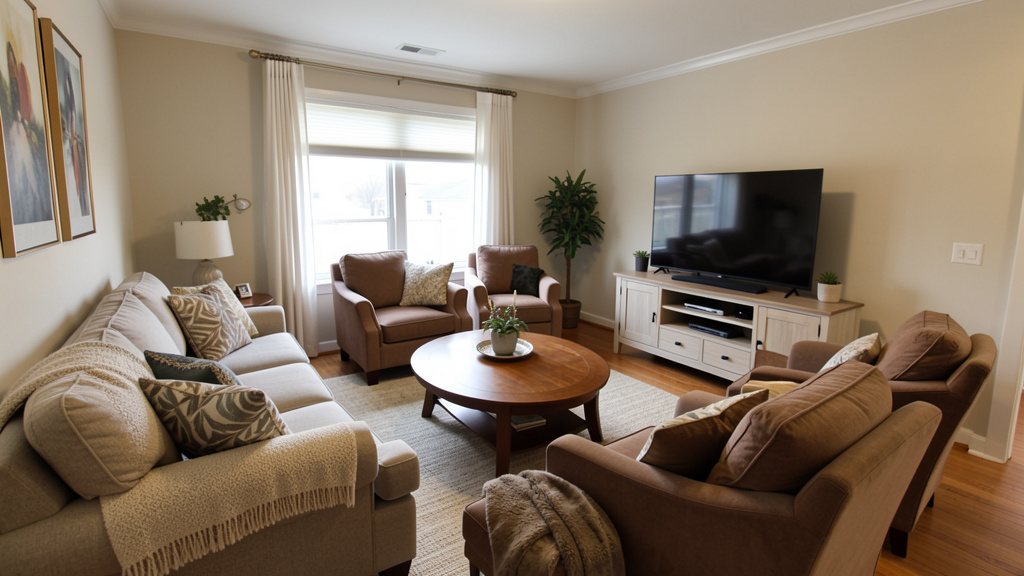
Move beyond rigid rules. Discover a flexible, evidence-informed approach to designing a living room that adapts to your rhythms—honoring connection, comfort, and the beautiful complexity of real life.
Your living room layout shapes how you move, connect, and unwind. Yet many spaces feel unintentional: furniture arranged by habit rather than purpose, seating that strains necks during movies or fragments conversation after dinner. This isn’t about aesthetics alone—it’s about aligning spatial design with human behavior. Drawing on established principles of environmental psychology, interior architecture standards, and observed patterns in residential living, this guide offers a practical, adaptable framework. Whether your days prioritize quiet talks, shared screen time, multi-generational gatherings, or fluid shifts between them all, you’ll find actionable strategies for furniture placement, lighting, acoustics, and responsive design tailored to your room’s dimensions and your household’s authentic needs. No dogma. No forced compromises. Just thoughtful, intentional space that works with you.
Introduction: Layout as a Reflection of Living
Step into any lived-in home and observe the living room. Notice where people naturally settle. See which chairs show wear. Watch how bodies orient during a chat versus screen time. These subtle cues reveal a quiet truth: spatial arrangement influences behavior. A room designed solely around a television may unintentionally discourage eye contact. A space optimized only for formal conversation might lack the relaxed comfort needed for unwinding. The tension between conversation-focused and media-focused layouts reflects deeper questions about daily life: How do we honor connection in a busy world? How do we create space for shared experiences without sacrificing individual comfort? Can one room gracefully support multiple needs?
Research in environmental psychology indicates that seating arranged in circular or U-shaped configurations tends to support greater eye contact, verbal exchange, and perceived closeness among occupants. Linear arrangements with a single focal point naturally draw attention forward, which can reduce lateral engagement. This isn’t about declaring one approach superior—it’s about alignment. When your layout reflects actual usage patterns (not an idealized vision), friction decreases, comfort increases, and the space feels intuitively right. Misalignment creates quiet stress: the family that treasures game nights but has all seating fixed toward a dark screen; the couple who hosts regularly but lacks a defined conversational zone. This guide begins with a foundational insight affirmed across decades of spatial design practice: Your living room must serve the people who inhabit it, not the furniture that fills it. By moving beyond generic placement tips, we’ll build a responsive strategy rooted in your lifestyle, your architecture, and human-centered principles that evolve with daily life.
The Responsive Living Room Framework: Mapping Your Space to Your Life
Forget the false choice between “conversation room” and “media room.” Most households exist along a fluid spectrum—and the most resilient layouts acknowledge this reality. Welcome to the Responsive Living Room Framework, a three-phase methodology informed by spatial design principles and observed usage patterns. This is a diagnostic tool to move from uncertainty to clarity, without prescribing a single “perfect” solution.
Phase 1: The Lifestyle Reflection (Clarity Before Movement)
Before measuring tape touches floor, pause for honest reflection. Involve all household members. Note patterns over one typical week. Disagreements here are valuable—they reveal core needs.
- Activity Pattern Log: Jot down key details each time the room is used:
- Who was present? (Solo, partner, children, guests)
- Primary activity? (Watching film, video calling, board games, reading, casual talking)
- Duration? (Brief pause, extended gathering)
- Observed friction? (“Had to raise voices,” “Glare on screen,” “Nowhere to set drinks”)
Example insight: “Tuesday evening: Family watched a movie. Children noted the screen felt high. Wednesday evening: Friends visited. Conversation felt scattered with chairs facing an unused TV.”
- Non-Negotiable Anchors: Identify what the room must support:
- Connection anchors: “Weekly gatherings with neighbors,” “Grandparents visit monthly and need accessible seating,” “Friday board game tradition.”
- Media anchors: “Sunday sports viewing,” “Shared movie ritual,” “Daily use of screen for yoga or learning.”
- Hybrid anchors: “Toddler play area visible from adult seating,” “Remote work requiring screen sharing,” “Quiet reading nook within shared space.”
- Spatial Reality Check: Walk the room slowly. Note:
- Fixed elements (fireplace, windows, doors, radiators, built-ins)
- Electrical outlet locations (critical for media setups and lamps)
- Natural light paths (morning sun on east wall? Afternoon glare on west window?)
- Traffic flow (How do people move from kitchen to patio? Where do coats land?)
This reflection transforms vague wishes (“I want it cozy”) into actionable insight (“We need a defined conversational cluster away from the TV wall, plus a flexible seating zone for weekend viewing”). Skipping this step often results in layouts that solve hypothetical problems rather than real ones.
Phase 2: Locating Your Position on the Spectrum
Visualize a spectrum. Left end: Conversation-Leaning (face-to-face interaction is primary; media is occasional). Right end: Media-Leaning (screen-based activities dominate weekly use; conversation happens around media). Center: Fluid Hybrid (genuine balance; activities shift daily or hourly).
- Conversation-Leaning Indicators: Frequent hosting, emphasis on dialogue, separate dedicated media room elsewhere, or lifestyle prioritizing unplugged connection. Layout focus: Unobstructed sightlines, intimate seating distances, flexible furniture groupings.
- Media-Leaning Indicators: Regular shared viewing rituals, sports enthusiasm, compact living where this room serves all entertainment needs. Layout focus: Optimal viewing angles/distances, glare management, acoustic comfort, seamless tech integration.
- Fluid Hybrid Indicators: Multi-generational households, open-concept layouts serving multiple functions, valuing both connection and shared media experiences. Layout focus: Adaptability, clear zone definition, modular elements, intuitive transitions.
Important nuance: Your position isn’t fixed. A new family member, changing work patterns, or seasonal shifts (more indoor time in winter) may gradually alter needs. The framework supports evolution. The goal isn’t a “forever-perfect” layout but a responsive system that grows with you.
Phase 3: Designing Your Adaptive Zone
An “Adaptive Zone” is a deliberately designed section of your room that can shift—physically or functionally—to support different activities. It’s the cornerstone of resilient design. Implementation varies by spectrum position:
- For Conversation-Leaning Spaces: Create a dedicated “Conversation Cluster” (sofa + two chairs + coffee table) in a gentle U-shape. Position the TV on a perpendicular wall or within a cabinet that closes. The Adaptive Zone is the cluster itself—lightweight armchairs on casters can pull closer for intimate talks or angle toward the TV for rare viewing.
- For Media-Leaning Spaces: Establish a “Viewing Core” (sectional facing TV at comfortable distance). The Adaptive Zone is a secondary seating nook: two armchairs and a small table near a window or fireplace. During non-screen time, this becomes a natural spot for coffee and conversation. A slim console behind the main sofa holds board games or books, transforming the space post-movie.
- For Fluid Hybrids: Implement complementary focal points. Example: Fireplace on north wall, TV mounted above it (with careful height consideration—see Media Layout section). Seating arranged in a wide arc facing the room’s center. During conversation, focus rests on the hearth. During media time, attention shifts slightly upward. The Adaptive Zone is the furniture: a swivel chair rotating 180 degrees, a modular ottoman serving as footrest or extra seat.
The Guiding Principle: A living room layout achieves harmony not by perfectly serving one activity, but when transitions between activities feel intuitive, effortless, and respectful of human comfort. The space should adapt to you, not demand constant adjustment from you.
Conversation-Focused Layouts: Cultivating Connection Through Spatial Design
When connection is a priority, every element should gently encourage engagement. This moves beyond “chairs facing each other” to leverage spatial psychology that reduces barriers and invites participation.
The Anatomy of an Effective Conversation Cluster
Imagine three people seated in a straight line facing a blank wall. Awkward, right? Now imagine them at the corners of a soft triangle. Natural eye contact. Easy inclusion. This geometric insight is foundational.
- The Gentle U-Shape or Triangle: Arrange seating so occupants form a loose U or triangle. This supports comfortable eye contact without neck strain. Practical guidelines:
- Across the cluster: 6–8 feet between outer seating edges (close enough for relaxed volume, far enough to avoid crowding).
- Coffee table height: 1–2 inches lower than sofa seat height. Prevents the table from becoming a visual barrier; allows easy eye contact over the surface.
- Table depth: Minimum 18 inches. Provides ample surface without forcing excessive forward lean.
- Sightline Consideration: Ensure no seat has its view of others blocked by high furniture backs, tall lamps, or architectural features. Test it: Sit in each chair. Can you make gentle eye contact with every other seat without sharp head turns? If not, adjust. Lower-back sofas (under 30 inches) help preserve sightlines across the room. High-backed chairs? Place them at the ends of the cluster, not blocking the central view.
- Inclusive Seating: Avoid arrangements where one seat feels isolated (e.g., a single chair perpendicular to a sofa). Every seat should feel equally valued. If space allows, include a fourth seat (an armchair or ottoman) to prevent the “odd person out” dynamic. For larger groups, consider two smaller clusters rather than one sprawling arrangement where voices compete.
Room Shape Implementation Guide
Standard Rectangular Room (approx. 12′ x 18′):
Approach: Float the conversation cluster away from walls. Center a 7-foot sofa on the longest wall. Position two armchairs at 45-degree angles facing the sofa ends, forming a soft U. Place the coffee table centered within the U.
Why it works: Floating furniture creates a defined “room within a room,” signaling a dedicated social zone. Angled chairs feel more inviting than rigid placements.
Common pitfall: Pushing all furniture against walls. This maximizes visual floor space but often creates a hollow, institutional feel that discourages gathering. Voices carry across empty space, reducing intimacy.
Tip: Place a narrow console table (12–14″ deep) behind the floating sofa. It anchors the cluster, provides surface for lamps or books, and defines the zone without blocking flow.
Square Room (approx. 15′ x 15′):
Approach: Create balanced flow. Position a round or oval coffee table centrally. Arrange four armchairs around it, slightly angled inward. If using a sofa, place it on one wall with two chairs opposite, ensuring the distance across the table is no more than 8 feet.
Why it works: Symmetry feels balanced and inclusive. Round tables eliminate “head of the table” dynamics, supporting egalitarian conversation.
Common pitfall: Placing a large rectangular sofa dead-center. This can dominate the space and make the room feel cramped. Square rooms benefit from balanced groupings.
Tip: Use an area rug large enough that all furniture legs (or at least front legs) rest on it. This visually “grounds” the conversation zone.
Narrow or Awkward Room (approx. 10′ x 20′):
Approach: Divide the space intentionally. Place the conversation cluster at one end (e.g., two armchairs and a loveseat facing each other across a narrow console table used horizontally). Use a bookshelf or tall plant to softly separate this zone from the rest of the room.
Why it works: Acknowledges the room’s shape rather than fighting it. Creates an intimate nook within the longer space.
Common pitfall: Trying to fit a full U-shaped cluster the entire length. This stretches conversation to uncomfortable distances.
Tip: Place a floor lamp between the two seating areas in the cluster. It provides task lighting and reinforces the connection point.
Furniture Choices That Support Connection
- Sofas: Prioritize seat depth of 22–26″ for relaxed posture during extended talks. Low backs (28–32″) maintain sightlines. Avoid deeply recessed sectionals that encourage isolation over interaction.
- Armchairs: Choose chairs with arms that slope downward slightly (“waterfall arms”) for easier conversational posture. Swivel bases are highly functional—they allow occupants to gently reorient toward new speakers without awkwardly shifting the entire chair.
- Tables: Round or oval shapes > rectangular for conversation clusters. If rectangular, ensure proportional depth. Nesting tables offer flexibility—pull one closer for a drink, tuck others away when space is needed.
- The “Lingering” Element: Include one non-seating feature that invites staying: a well-lit bookshelf within reach, a small table holding a puzzle in progress, a basket of cozy throws. These subtle cues encourage connection to deepen.
Addressing Occasional Media Use
A frequent consideration in conversation-focused layouts: “But we do watch TV sometimes!”
Mount the TV on a perpendicular wall (not the main focal wall of the cluster).
Use a slim media console that doesn’t dominate the space.
Install a discreet cabinet with doors to conceal the TV when not in use.
Key detail: Position the TV so viewing requires only a slight head turn from primary conversation seats—not a full-body reorientation. This respects the room’s primary purpose while accommodating secondary needs. A modest 32–40″ screen is often sufficient for occasional viewing and feels less imposing than a large display.
Media-Focused Layouts: Supporting Immersion and Comfort
A media-optimized layout considers human physiology, acoustics, lighting, and the subtle psychology of relaxation. It transforms passive watching into an intentional, comfortable experience.
The Viewing Core: Thoughtful Placement Guidelines
TV Mounting Height: Aligning with Comfort
The center of your screen should align closely with seated eye level. For typical seating, this often places the screen center 40–48 inches from the floor. Why?
Physiology: A slight downward gaze (5–15 degrees) is generally the most relaxed position for neck muscles during extended viewing. Looking upward can contribute to strain over time.
Larger screens: For screens 65″+, mounting slightly higher (center at 48–52″) may be appropriate if seating is positioned farther back (see distance guidelines below).
Fireplace mounting note:* Mounting a TV above a functional fireplace is generally not recommended by ergonomics resources due to the typical height of mantels (often 50–60+ inches), which can encourage upward neck strain. If unavoidable:
* Use a full-motion mount allowing significant downward tilt.
* Position seating farther back to reduce the upward viewing angle.
* Seriously evaluate alternative locations for long-term comfort.
Viewing Distance: A Refined Perspective
Distance depends on screen resolution, content type, and personal preference. Consider this practical guide:
| Screen Size | Minimum Distance (4K) | Comfortable Range (4K) | Notes |
|---|---|---|---|
| 55-inch | ~4.5 feet | 6 – 9 feet | Closest seat should be no nearer than min distance to avoid pixel visibility |
| 65-inch | ~5.5 feet | 7 – 11 feet | Sports viewers may prefer the closer end; cinematic viewers the farther |
| 75-inch+ | ~7 feet | 9 – 14 feet | Ensure ceiling height and room depth accommodate this range |
| For 1080p | Add ~25% | Add ~25% | Lower resolution benefits from greater viewing distance |
- Personal calibration: Sit in your primary viewing seat. Hold your fist at arm’s length. The screen should fill your field of view such that your fist covers approximately the screen width. Adjust closer or farther based on comfort.
- Multiple seating rows: In dedicated setups, tiered seating ensures clear sightlines. In living rooms, consider armchairs behind the main sofa with slightly higher seat heights.
Managing Glare: Preserving Visual Comfort
Identify reflections: Sit in viewing position at different times of day. Note where sunlight or artificial light reflects on the screen.
Solutions:
* Window treatments: Light-filtering roller shades or blackout curtains (layered for flexibility) are highly effective.
* TV placement: Avoid positioning the screen directly opposite windows. Perpendicular placement often minimizes reflections.
* Matte screen protectors: Can reduce glare on glossy screens (verify compatibility first).
* Bias lighting: A soft, dimmable LED strip behind the TV, emitting light around 6500K (daylight white), can reduce eye strain by minimizing contrast between a bright screen and a dark room. Keep brightness low—barely perceptible.
Seating Strategy for Shared Comfort
- The Gentle Arc: Arrange seating in a subtle curve facing the screen. This supports a direct, centered view from every seat. For sectionals, choose configurations that naturally form this arc.
- Seat Depth and Support: Prioritize seat depths of 24–28″ with moderate recline for relaxation. Avoid extreme “zero-gravity” recliners in shared zones—they can isolate the user and block sightlines for others. Look for seating with individual cup holders and gentle recline mechanisms if desired.
- Armrest Consideration: Wide, padded armrests support comfort during long sessions. Measure carefully to ensure adjacent seats can be positioned close enough for quiet conversation between viewing. Test the distance with arms down.
- The Peripheral Seat: Include at least one seat (an armchair) positioned slightly off the main viewing axis. This accommodates glances at a phone, checking on others, or commenting without raising volume—acknowledging that pure immersion isn’t always the goal, even in media-focused rooms.
Acoustic Considerations: Clarity and Comfort
Poor acoustics disrupt immersion. Dialogue should be clear without excessive volume; sound effects should feel enveloping, not overwhelming.
- Absorption (Reducing Echo): Hard surfaces (wood floors, bare walls, large windows) can create reverberation.
- Solutions: Area rugs with thick pads (minimum 8×10 ft under seating area). Heavy fabric curtains. Upholstered furniture. Wall-mounted fabric art or tapestries.
- Diffusion (Natural Sound Scattering): Prevents “dead spots” and creates a more enveloping sound field.
- Solutions: Bookshelves filled with books of varying depths. Architectural details. Strategically placed plants with broad leaves.
- Bass Management: Low frequencies can build up in corners.
- Solutions: Place the subwoofer on a dense isolation pad. If bass feels overwhelming, try moving it away from corners toward a mid-wall position. For dedicated setups, acoustic panels in corners can help.
- Speaker Placement (Soundbars/Surround):
- Soundbar: Centered directly below or above TV, angled slightly upward if possible.
- Rear speakers: Positioned slightly behind the main seating area, aimed toward listeners’ ears. Height: 1–2 feet above seated ear level.
- Note: Keep seating at least 3 feet away from rear walls to minimize bass buildup.
Integrating Technology Thoughtfully
Cluttered wires and blinking lights disrupt ambiance. Integrate technology with care:
- Cable Management: Use in-wall rated kits (consult a professional if unsure). Run wires through baseboard channels. For rentals, cord covers painted to match walls offer a clean solution.
- Simplified Control: A unified remote system (universal remote or smart home hub) reduces frustration. Label buttons clearly.
- Ventilation Matters: Never fully enclose AV equipment in a sealed cabinet. Heat buildup can damage electronics. Ensure cabinets have ventilation slots, mesh backs, or active cooling. Leave 2–3 inches of space around components.
- Transition Ritual: Designate a small basket or drawer near seating for remotes. Placing remotes inside after use signals a shift out of media mode and reduces visual clutter.
The Fluid Hybrid Approach: Designing for Graceful Transitions
For many households, the goal isn’t choosing between conversation and media—it’s creating a space that serves both with minimal friction. This requires strategic zoning, intelligent furniture choices, and clear visual cues. A hybrid layout isn’t a compromise; it’s a sophisticated integration.
Complementary Focal Points: Fireplace and TV Integration
This common scenario requires careful execution to avoid visual competition or awkward angles.
- The Adjacent Wall Approach (Often Preferred):
Place the fireplace on one wall (e.g., north). Mount the TV on the adjacent wall (e.g., east), angled slightly inward toward the room’s center. Arrange seating in a wide arc facing the corner between these walls.- Why it works: During conversation, the fireplace serves as a natural focal point. During media time, viewers shift gaze slightly. No significant neck strain. The room feels balanced.
- Key details:
- Mount the TV at appropriate seated eye level (center ~42″ from floor) on its wall, not raised to match fireplace height.
- Use a full-motion mount allowing 25–30 degrees of swivel for fine-tuning.
- Ensure distances from primary seats to both focal points fall within comfortable ranges.
- Shared Wall Approach (Use with Caution):
TV mounted above fireplace. Viable only if:- Fireplace is non-functional or rarely used (heat concerns).
- Mantel height is relatively low (under 48″ to top of mantel).
- A full-motion mount pulls the TV down significantly and tilts forward.
- Primary seating is positioned farther back.
- Recommendation: If your fireplace is functional and used regularly, the adjacent wall approach is often more comfortable long-term. Prioritize ergonomic well-being over symmetrical aesthetics.
Modular and Mobile Furniture: The Heart of Adaptability
Invest in pieces designed for flexibility. This is where thoughtful allocation pays dividends.
- Modular Sectionals: Choose systems where chaise lounges, armless chairs, and corner units can be reconfigured. An “armless chair” module can be pulled out to face a conversation cluster; a chaise can shift sides to alter flow.
- Swivel and Glide Chairs: Armchairs with smooth 360-degree swivel bases are invaluable. During movie time, they face the screen. During conversation, a gentle turn reorients the occupant. Glide mechanisms add comfort without sacrificing mobility.
- Nesting and Mobile Surfaces:
- Nesting tables: Stack compactly when not needed; pull one forward for a drink during TV time, position two between chairs for game night.
- Carts on casters: A slim cart holds remotes, blankets, or board games. Roll it into the conversation zone for serving; tuck it beside the TV console during movies.
- Multi-Role Ottomans: Choose storage ottomans with firm, flat tops. They serve as:
- Footrests during TV time
- Extra seating pulled into the conversation cluster
- Coffee table surface (with a tray)
- Hidden storage for throws or games
Defining Zones Without Walls: Visual Cues for Flow
In open-concept homes, subtle boundaries prevent the room from feeling like a furniture warehouse.
- Area Rugs as Zone Anchors:
- Place one large rug (9×12 ft minimum) under the entire media seating area.
- Place a second, smaller rug (5×8 ft) under the conversation cluster (e.g., two armchairs and a side table near a window).
- Key: Leave 12–18 inches of bare floor between rugs. This creates clear visual separation. Choose rugs with complementary but distinct patterns/colors to reinforce zone identity.
- Layered Lighting for Activity Signaling:
- Media Zone: Recessed downlights on dimmers; bias lighting behind TV; a directional floor lamp for reading during credits.
- Conversation Zone: A floor lamp with warm, diffuse light (2700K bulb); wall sconces flanking the seating area; flameless candles on the side table.
- Control: Use smart bulbs or multi-circuit dimmers. A switch labeled “Movie Mode” dims conversation zone lights and activates bias lighting. “Social Mode” brightens the conversation nook and dims the media zone.
- Soft Transitions:
- A tall, slender plant (like a fiddle leaf fig) placed between zones softens the transition without blocking sightlines.
- A low bookshelf (36″ high) can separate zones while providing storage. Keep the top clear or use low decorative objects to maintain visual connection.
- Avoid: Tall room dividers or solid screens—they create barriers and can make the space feel smaller.
The Gentle Transition Ritual
Hybrid layouts shine when shifts feel effortless. Establish a simple, shared practice:
- After Viewing: As credits roll, one person might:
- Swivel accent chairs 90 degrees to face the conversation cluster.
- Roll the mobile cart to the side table.
- Turn on the conversation zone floor lamp.
- Adjust the main coffee table slightly closer to the sofa.
- Before Social Time: Before guests arrive:
- Pull the storage ottoman into the center of the conversation cluster.
- Place board games on the nesting tables.
- Dim the media zone lights completely.
- Light flameless candles.
This isn’t about perfection—it’s about shared intentionality. These small, consistent actions help the household see the space as adaptable, reducing resistance to change. The room becomes a responsive partner in daily life.
Navigating Common Spatial Challenges: Practical Solutions
Theory meets reality in the imperfect spaces we inhabit. Let’s address persistent layout challenges with actionable, adaptable strategies.
Compact Living Rooms (Under 200 Sq Ft)
- Challenge: Every inch matters. Furniture can feel overwhelming. Distinct zones may seem impossible.
- Mindset Shift: Prioritize multi-functionality over multiple dedicated zones. One piece must serve multiple roles exceptionally well.
- Action Plan:
- Plan Before Purchasing: Create a to-scale floor plan (graph paper or free app). Cut out paper templates of furniture. Test arrangements before buying.
- Vertical Space Utilization: Wall-mount the TV. Install floating shelves for media/books. Use a wall-mounted drop-leaf table for dining or laptop use. Frees up precious floor space.
- Strategic Seating: A loveseat (5–6 ft wide) is often more versatile than a full sofa. Pair with one versatile armchair on casters (swivel + wheels). The chair moves: facing TV for movies, pulled beside loveseat for conversation, tucked in a corner when floor space is needed.
- Vertical Storage: A tall, narrow bookshelf (12″ deep) utilizes wall height without consuming floor space. Use baskets on shelves for hidden storage.
- Light and Space Illusion: Place a large mirror opposite a window to reflect light and create a sense of depth. Avoid placing mirrors where they reflect TV glare.
- Lighting Strategy: Rely on wall sconces and upward-shining floor lamps instead of bulky table lamps. Keeps surfaces clear.
- Hybrid Tip: Use a TV stand with doors. When closed, it resembles a stylish console. During conversation-focused times, close the doors—visually “removing” the TV from the focal point.
Awkward Layouts: Long & Narrow, Multiple Doors, Angled Walls
- Core Principle: Work with the room’s natural flow, don’t fight it. Define zones that acknowledge the shape.
- Long & Narrow Room (e.g., 10′ x 22′):
- Pitfall: Placing all furniture along the long walls, creating a “bowling alley” effect.
- Solution: Divide into two distinct zones.
- Zone 1 (Near Entry): Conversation nook. Two armchairs angled toward each other with a small round table between them. A narrow console behind chairs holds lamps.
- Zone 2 (Far End): Media zone. Loveseat centered on the short wall, TV mounted opposite. Area rug defines this zone.
- Flow: Leave a clear 36-inch pathway down the center. Use a runner rug (2.5′ wide) along the pathway to guide movement.
- Room with Multiple Doorways:
- Pitfall: Placing furniture where doors swing open, creating hazards.
- Solution:
- Trace door swing arcs on the floor with painter’s tape.
- Keep all furniture outside these arcs.
- Position the main seating cluster away from high-traffic door paths.
- Use low-profile furniture (e.g., storage ottoman instead of a coffee table with legs) near doorways to minimize bump risks.
- Angled Walls or Bay Windows:
- Pitfall: Ignoring the feature, leaving awkward empty space.
- Solution: Embrace it as a zone anchor.
- Bay Window: Place a custom curved bench seat with storage underneath. Add cushions and throw pillows. This becomes a dedicated reading nook or secondary conversation spot. Position a small side table within reach.
- Angled Wall: Place a tall plant or floor lamp in the angle. Position the end of your sofa or a bookshelf to follow the angle, making it feel intentional.
Multi-Generational and Accessibility Considerations
A truly functional layout serves everyone who uses the space, regardless of age or mobility.
- Clear Pathways: Maintain minimum 36-inch wide unobstructed pathways between furniture pieces. Critical for walkers, wheelchairs, or navigating with a tray. Avoid “furniture islands” that require tight weaving.
- Seating Variety is Essential:
- Firm, Higher Seats (19–21″ seat height): Easier for some to rise from. Include at least two armchairs with sturdy arms for leverage.
- Lower, Deeper Seats: For those who prefer lounging.
- Avoid: Deep sectionals with very low seat heights (<17″) as the only seating option—they can be challenging to exit for some.
- Strategic Support Points: Ensure stable furniture (like a solid wood console table) is positioned near seating areas where someone might need light support standing up. Avoid placing fragile side tables in these locations.
- Lighting for Safety and Comfort:
- Eliminate dark corners with layered lighting.
- Install motion-sensor nightlights along pathways to bathrooms.
- Use lamp timers or smart plugs to ensure a soft light is always on in the evening.
- Choose lamps with easy-grip switches (rocker switches > tiny knobs).
- Universal Design Touches:
- Round sharp coffee table corners.
- Secure area rugs with non-slip pads.
- Keep frequently used remotes in a consistent, accessible location.
- Consider voice-controlled smart home devices for lights, TV, and temperature—reduces need to navigate remotes or reach switches.
Working With Architectural Features: Low Ceilings, Sloped Roofs, Columns
- Low Ceilings (<8 ft):
- Strategy: Create vertical illusion.
- Do: Use floor-to-ceiling curtains hung close to the ceiling. Choose low-profile furniture (sofas with exposed legs, slim armchairs). Paint the ceiling a shade lighter than walls. Use vertical stripes on one accent wall.
- Avoid: Heavy crown molding, tall bookshelves that touch the ceiling, dark ceiling colors.
- Sloped Ceilings (Attic Conversions):
- Strategy: Zone by height.
- Place seating and primary activities under the highest part of the ceiling. Use the lower eave areas for storage (low bookshelves, window seats), plants, or non-essential furniture. Never force seating into a cramped, low-ceilinged corner.
- Structural Columns:
- Strategy: Integrate, don’t hide.
- Wrap the column in matching wood or paint to blend with walls. Mount floating shelves around it for display/storage. Place a tall plant beside it. Position seating so the column feels like part of the arrangement (e.g., place an armchair with its back to the column). Never leave it as a bare obstacle in a pathway.
Furniture Selection Guide: Choosing Pieces That Serve Your Purpose
Furniture is functional infrastructure. Selecting the right pieces prevents daily friction and enhances lived experience. Let’s explore critical details often overlooked.
Sofas & Sectionals: The Foundation of Flow
- Seat Depth: Matching Posture to Purpose
- Conversation Focus: 22–24 inches. Encourages upright, engaged posture. Easier to lean forward slightly during dialogue. Helps maintain eye contact.
- Media Focus: 25–28+ inches. Prioritizes lounging and relaxation. Ideal for reclining during movies. Note: Depths over 28″ may make it difficult for some to place feet flat on the floor; test before buying.
- Hybrid Solution: 24–26 inches. A versatile range. Allows relaxed posture without sacrificing conversational engagement. Look for models with adjustable headrests or lumbar support.
- Back Height: Preserving Sightlines
- Critical Consideration: For conversation clusters, choose sofas with back heights under 32 inches. This helps preserve sightlines across the room. High backs (>36″) can create visual barriers.
- Exception: In media-focused zones where all seating faces one direction, higher backs (34–38″) may provide neck support and a “cocooning” feel. Ensure they don’t block sightlines for people seated behind.
- Arm Style: Function in the Details
- Track Arms (Straight, Low): Modern look. Easier to place side tables close. Good for small spaces.
- Rolled Arms (Curved): Comfortable for resting elbows during long conversations. Creates a softer silhouette.
- Waterfall Arms (Sloping Downward): Excellent for conversation—allows easier turning toward adjacent seats.
- Consideration for Conversation: Very wide rolled arms can increase the sofa’s effective width and potentially block sightlines between seats.
- Sectional Configuration: Mapping to Your Space
- L-Shaped: Ideal for defining zones in open rooms. The long side anchors against a wall; the short side (chaise) creates a boundary. Best for media focus or hybrid layouts.
- U-Shaped: Powerful for large conversation clusters. Creates an intimate, inclusive circle. Requires significant space (min. 14′ x 14′). Can feel overwhelming in smaller rooms.
- Modular: Ultimate flexibility for hybrids. Components can be rearranged as needs change. Ensure connectors are sturdy. Measure doorways carefully—modular pieces must fit through!
- Chaise Placement: Right-arm facing (RAF) vs. Left-arm facing (LAF) matters. Sketch your room. Which side has the window? The door? The TV? Choose chaise orientation that complements traffic flow.
Armchairs: The Adaptive Powerhouse
Never underestimate the armchair. In hybrid layouts, it’s indispensable.
- Swivel Bases: Highly Valuable for Hybrids
A smooth 360-degree swivel base transforms an armchair. During movie time: facing the screen. During conversation: a gentle turn engages the group. During solo reading: oriented toward a window. Look for bases with smooth bearings and slight resistance (prevents accidental spinning). - Seat Height & Depth Synergy
Armchair seat height should closely match your sofa’s seat height (±1 inch). Mismatched heights can create awkward posture during conversation. For media zones, consider chairs with slightly deeper seats (24″+) and recline function. For conversation clusters, prioritize chairs with firm, supportive seats and moderate depth (20–22″). - Arm Height Consideration
Lower arms (under 24″ from floor) can make chairs feel more open and accessible. Higher arms (26″+) offer more support. For multi-generational homes, choose chairs with arms sturdy enough to provide leverage when standing (check weight capacity). - The “Conversation Chair” Checklist:
- Swivel base (highly recommended)
- Seat height matches main sofa
- Back height under 34″ (supports sightlines)
- Arm height allows easy turning toward others
- Fabric is durable yet inviting (performance velvet, tightly woven twill)
- Casters (optional but useful for hybrids)
Tables: Function Beyond Surface
Tables define zones, hold essentials, and influence movement. Choose with intention.
- Coffee Tables: Shape Informs Function
- Round/Oval: Ideal for conversation. No sharp corners to bump knees. Encourages circular movement. Perfect for U-shaped seating clusters.
- Rectangular: Best for media zones aligned with a sofa. Provides long surface for remotes, drinks, snacks. Choose one with tapered legs or open base to preserve sightlines.
- Critical Dimension: Table height should be 1–2 inches lower than sofa seat height. This allows comfortable leg positioning and easy reach.
- Nesting Tables: Hybrid Flexibility
A set of 2–3 tables that stack compactly offers unmatched adaptability. Pull one forward for a drink during TV time. Place two between armchairs for game night. Tuck all away when floor space is needed. Choose sets with varying heights for visual interest. - Console Tables: Zone Definition
Place behind a floating sofa to anchor the conversation cluster. Use in narrow spaces between zones. Ideal depth: 12–14 inches. Height should match sofa back height or be slightly lower. Use for lamps, books, or displaying art—avoid clutter accumulation. - Ottomans: The Ultimate Multi-Tasker
- Storage Ottoman: Holds blankets, board games, or toys. Firm top serves as footrest, extra seat, or impromptu table (add a tray).
- Tufted Ottoman: Adds texture and elegance. Best used as footrest or accent seat.
- Nesting Ottoman Set: Like nesting tables, but softer. Pull one out for extra seating; stack when not needed.
- Tip: Choose ottomans with handles or lightweight construction—they’re meant to be moved frequently in adaptive layouts.
Storage Solutions: Containing Clutter, Preserving Flow
Clutter disrupts functional layout. Strategic storage keeps zones clear and purposeful.
- Media Consoles:
- Width: Should be at least as wide as your TV screen (ideally 2–4 inches wider on each side). Prevents a top-heavy appearance.
- Ventilation: Must have perforated back panels or side vents. Never block vents with walls or decor.
- Cable Management: Look for models with built-in holes or channels for wires. Use adhesive cable clips inside to keep cords organized.
- Doors vs. Open Shelving: Doors hide clutter but require opening/closing. Open shelving displays decor but demands tidiness. Hybrid solution: Console with mix of closed cabinets and open shelves.
- Bookshelves as Room Dividers:
- Height: 36–48 inches is ideal for zone separation without blocking light or sightlines.
- Depth: 10–12 inches holds books and small decor without protruding far into pathways.
- Placement: Position perpendicular to main wall. Leave 6–12 inches gap between shelf and wall for visual lightness. Style with books, plants, and a few meaningful objects—avoid overcrowding.
- Hidden Storage Heroes:
- Storage Benches: Place at the foot of a conversation cluster or under windows. Holds throws, pillows, games.
- Ottomans with Lift-Top: As mentioned, invaluable.
- Baskets & Bins: Use uniform baskets (seagrass, canvas) on open shelves. Label discreetly. Creates cohesive look while containing items.
- Floating Shelves: Install above sofa or in unused wall space. Keep styling minimal—3–5 items max per shelf. Prevents visual clutter.
Lighting and Acoustics: The Sensory Layer of Layout
Great layouts engage all senses. Lighting sets mood and enables function; acoustics shape comfort and clarity. Neglect these, and even perfect furniture placement feels incomplete.
Lighting Layers: Crafting Atmosphere and Utility
Move beyond a single overhead light. Master the three-layer approach:
- Ambient Lighting (The Foundation):
- Purpose: Provides overall, shadow-minimizing illumination.
- Sources: Recessed downlights (use dimmers!), ceiling-mounted fixtures with diffusers, cove lighting.
- Tip: Avoid placing recessed lights directly over seating areas—they can cast unflattering shadows on faces during conversation. Position lights between seating zones and walls.
- Hybrid Application: Install separate dimmer circuits for “front half” (media zone) and “back half” (conversation zone) of the room.
- Task Lighting (The Precision Tool):
- Purpose: Illuminates specific activities without flooding the whole room.
- Sources: Adjustable floor lamps (arch lamps over sofas), swing-arm wall sconces beside chairs, under-cabinet lighting on consoles.
- Conversation Focus: Place a floor lamp between two armchairs in a cluster. Direct light downward onto the seating area, not into eyes. Use warm bulbs (2700K) for an inviting glow.
- Media Focus: Bias lighting behind TV (6500K LED strip). A small, dimmable lamp on a console behind seating provides just enough light to navigate without washing out the screen.
-
Accent Lighting (The Mood Setter):
- Purpose: Highlights architectural features, art, or greenery; adds depth.
- Sources: Picture lights, track lighting aimed at art, LED strips under shelves, flameless candles.
- Hybrid Magic: Use accent lighting to “activate” zones. A picture light over art in the conversation nook draws the eye there during social time. Uplighting a plant near the TV console enhances media ambiance.
-
Smart Lighting Integration (Optional):
- Program scenes: “Movie Night” (dims ambient lights, activates bias lighting), “Game Night” (brightens task lighting over table), “Morning” (gradually brightens ambient lights).
- Use motion sensors in pathways for safety.
- Tip: Place smart plugs on frequently used lamps. Control via voice or app without rewiring.
Acoustic Tuning: From Echo Chamber to Comfort Zone
Hard surfaces create echoes; soft surfaces absorb sound. Balance is key.
- The Clap Test: Stand in the center of your room. Clap sharply once. Listen:
- Sharp, lingering echo? Too many hard surfaces. Needs absorption.
- Dead, flat sound? Too much absorption. Needs diffusion.
- Warm, quick decay? You’re in a balanced range.
- Absorption Solutions (Reduce Echo):
- Floor: Area rug with thick pad (minimum 8×10 ft under main seating). Wool rugs absorb well.
- Walls: Heavy fabric curtains (floor-to-ceiling). Fabric wall panels. Bookshelves filled with books.
- Furniture: Upholstered pieces (sofas, chairs). Note: Large expanses of bare leather can reflect sound.
- Diffusion Solutions (Scatter Sound Naturally):
- Why it matters: Prevents “dead spots” and creates a more enveloping, natural sound field—critical for clear dialogue during conversation and immersive audio during movies.
- How: Bookshelves with books of varying depths. Wall-mounted shelves with decor objects. Plants with broad leaves (fiddle leaf fig, monstera). Textured wall coverings.
- Bass Management (For Media Zones):
- Challenge: Low frequencies can build up in corners, causing “boomy” sound.
- Solution: Place bass traps (triangular acoustic panels) in ceiling-wall and floor-wall corners behind seating. For less visible solutions, use thick, heavy curtains in corners. Position the subwoofer away from corners if bass feels overwhelming; try mid-wall placement.
- Conversation Clarity Boosters:
- Place a soft rug between conversation seats—not just under the coffee table. This absorbs sound bouncing off the floor between speakers.
- Avoid placing large, flat surfaces (like a glass coffee table) directly between seats—they can reflect sound unpredictably.
- A small water feature (tabletop fountain) adds gentle white noise that masks distant household sounds without disrupting close conversation.
The Sensory Integration Checklist
Before finalizing your layout, verify these sensory elements:
- [ ] Lighting: Can lights dim sufficiently for movie time? Is there warm, focused light for reading in every seat? Are switches conveniently located near room entrances and seating areas?
- [ ] Acoustics: Does the clap test yield a warm, quick decay? Are hard floors covered sufficiently under seating areas? Is the TV positioned to minimize glare from windows/lights?
- [ ] Thermal Comfort: Are seating areas away from direct drafts (vents, doors)? Is there a cozy throw within reach of every seat for cooler evenings?
- [ ] Subtle Sensory Cues: Is there a gentle, pleasant ambient element? (e.g., essential oil diffuser on low setting, beeswax candle). Avoid strong artificial fragrances that may trigger sensitivities.
- [ ] Tactile Variety: Are there multiple textures to engage touch? (Smooth wood table, nubby wool rug, soft velvet pillow, cool ceramic lamp base). This subconscious layer enhances comfort and perceived quality.
Illustrative Layout Examples
Theory gains clarity through application. These examples illustrate how the Responsive Living Room Framework addresses common scenarios. Dimensions and solutions reflect typical residential challenges and adaptable strategies.
Example 1: Urban Apartment (Conversation-Leaning Hybrid)
- Scenario: A couple in a 750 sq ft downtown apartment hosts small groups (4–6 people) weekly for conversation. They watch movies 1–2 times per week. Their priority: creating a space where guests feel immediately welcome and conversations flow naturally.
- Initial Challenges:
- Full-sized sofa and loveseat pushed against opposite walls.
- TV mounted centrally on the main wall, dominating the visual field.
- Large coffee table blocked the pathway to the balcony.
- Guests sat facing the TV even during conversation; the space felt like a waiting room.
- Framework Application:
- Lifestyle Reflection: Revealed 70% conversation-focused usage (hosting), 30% media. Non-negotiable: “Must feel inviting the moment guests walk in.”
- Spectrum Position: Conversation-Leaning Hybrid.
- Adaptive Zone Design:
- Removed bulky entertainment center.
- Mounted a 43″ TV on the side wall (perpendicular to entry) using a full-motion mount.
- Created a floating conversation cluster: 72″ low-back sofa centered on the main wall, two swivel armchairs at 45-degree angles forming a soft U.
- Placed a round 36″ coffee table (1″ lower than sofa seat) within the U.
- Added a narrow console behind the sofa with a warm-glow floor lamp.
- Used an 8×10 ft wool rug to anchor the entire cluster.
- Key Insights:
- TV Placement: Mounting on the side wall was pivotal. During conversation, the TV is visually secondary. For movie nights, swiveling chairs face it easily. The modest screen size felt less imposing.
- Sightlines: The low-back sofa ensured everyone could see each other’s faces across the cluster.
- Flow: Floating furniture created a clear pathway to the balcony. The console behind the sofa provided surface for drinks without blocking movement.
- Lighting: Replaced harsh overhead lighting with dimmable recessed lights + layered sources: floor lamp behind sofa, swing-arm sconce beside each armchair, small table lamp on console. “Movie Mode” dims all to low levels; “Social Mode” brightens task lighting.
- Outcome: Guests naturally gravitate to the sofa area upon arrival. Conversations flow with ease. Movie nights remain comfortable, but the room doesn’t visually prioritize the TV when it’s not in use. The 5-minute reset (swiveling chairs toward TV) is seamless. Total adjustments focused on rearrangement, rug, and lighting.
Example 2: Suburban Family Room (Fluid Hybrid)
- Scenario: A family of four (parents and school-aged children) in a 400 sq ft open-concept family room adjacent to the kitchen. Activities include homework, board games, movie nights, and casual hanging out. Priority: One space that works for everyone without constant friction over the remote.
- Initial Challenges:
- Large L-shaped sectional dominated the room, all seats facing the TV.
- TV mounted too high above the fireplace.
- No dedicated space for board games or homework.
- Children sprawled on the floor during movies; parents experienced neck strain.
- Framework Application:
- Lifestyle Reflection: Revealed near 50/50 split: Media (sports, movies) 4x/week; Conversation/Activities (games, homework, chatting) 5x/week. Non-negotiables: “Clear pathway from kitchen,” “Seating for 6+,” “TV visible from kitchen island.”
- Spectrum Position: Fluid Hybrid.
- Adaptive Zone Design:
- Replaced L-sectional with a modular system: 84″ sofa + two armless chairs + movable chaise.
- Mounted a 65″ TV on the adjacent wall to the fireplace (not above it) using a full-motion mount. Positioned at appropriate height (center ~42″ from floor).
- Created two defined zones with rugs:
- Media Zone: 9×12 ft rug under sofa and chairs facing TV wall.
- Activity Zone: 5×8 ft rug under two armchairs and a small round table near the window.
- Added a mobile cart on casters holding board games, art supplies, and remotes.
- Installed dual-circuit dimmers: “Movie Circuit” (lights near TV), “Activity Circuit” (lights near window nook).
- Key Insights:
- Complementary Focal Points: The fireplace remains a visual anchor. The TV on the adjacent wall allows easy viewing from the kitchen island and all seating. The full-motion mount adjusts the angle for optimal viewing from both zones.
- Modular Furniture: The armless chairs are highly functional. Pulled into the Activity Zone for homework; added to the Media Zone for movie nights; reconfigured for sleepovers. The chaise moves to create a wider aisle when needed.
- Zone Definition: Rugs visually separate functions without walls. Children understand “rug time” means board games; parents know the Activity Zone is for quiet reading.
- Acoustics: Added a thick rug pad under the main rug, heavy curtains on the large window, and a bookshelf filled with books along one wall. Reduced echo significantly during lively family discussions.
- Outcome: Game night happens weekly—it takes moments to pull the chairs into the activity zone. Movie nights are comfortable for everyone. The mobile cart eliminates “where are the game pieces?” frustration. The layout respects both connection and media needs without privileging one over the other.
Example 3: Multi-Generational Living Room (Accessibility-Focused)
- Scenario: A household including an older adult who uses a cane, a working adult, and a teenager. Priorities: Safety and dignity for the older adult, functionality for remote work, and space for gaming/media. Core value: “A space where everyone feels respected and included.”
- Initial Challenges:
- Deep, low-seated sectional difficult for the older adult to rise from.
- Cluttered pathways with side tables and floor lamps.
- Poor lighting in seating areas; glare on the TV screen.
- No dedicated quiet space away from TV noise.
- Framework Application:
- Lifestyle Reflection: Revealed layered needs: older adult’s comfort/safety (priority), remote work needs, teen’s media use. Non-negotiables: “Clear 36-inch pathways,” “Firm, higher seating,” “Quiet zone away from TV.”
- Spectrum Position: Conversation-Leaning, with strong accessibility considerations.
- Adaptive Zone Design:
- Replaced sectional with:
- Two firm, higher-seat armchairs (21″ seat height) with sturdy arms.
- A loveseat (medium depth) for the working adult and teen.
- Created distinct zones:
- Conversation Nook: Armchairs angled toward each other near a window, small round table between them. Dedicated floor lamp with easy-grip switch.
- Media/Work Zone: Loveseat facing TV on the opposite wall. TV mounted at appropriate height; bias lighting installed.
- Installed motion-sensor path lights along the route to the bathroom.
- Added non-slip pads under all rugs. Rounded sharp corners on existing furniture with edge guards.
- Placed all remotes in a consistent, accessible basket on the conversation nook table.
- Replaced sectional with:
- Key Insights:
- Seating Variety: Critical success factor. The higher-seat armchairs provide security and ease of standing. The loveseat accommodates work-from-home needs (facing away from the nook for privacy during calls) and gaming.
- Pathway Priority: Measured and maintained 36-inch clear paths. Removed one side table that encroached on flow.
- Lighting for Safety & Dignity: Layered lighting eliminated dark spots. Motion-sensor lights prevent nighttime falls. Warm, focused light in the conversation nook makes the space feel special and intentional.
- Glare Control: Installed light-filtering roller shades on the large window. Positioned TV to avoid direct window reflection.
- Outcome: The older adult has a peaceful, accessible spot for afternoon tea while remaining part of the household flow. The working adult can take video calls without disturbing others. The teen respects the designated zones. The layout fosters intergenerational respect through intentional design.
Your Questions, Answered
Q: How do I arrange a living room with a fireplace and a TV without neck strain or visual clutter?
A: The adjacent wall approach is often the most comfortable solution. Place the fireplace on one wall, mount the TV on the neighboring wall using a full-motion swivel mount. Arrange seating in a gentle arc facing the corner between these walls. This allows natural shifting of focus: toward the fireplace hearth during conversation, slightly toward the TV during viewing. Ensure the TV is mounted at appropriate seated eye level (center approximately 40–48″ from floor) on its wall, not raised to match the fireplace height. If mounting above a non-functional fireplace is the only option, use a full-motion mount that allows significant downward tilt and position seating farther back to reduce the upward viewing angle. Prioritize long-term comfort over symmetrical aesthetics.
Q: What is the ideal distance between seats in a conversation cluster?
A: Aim for 6 to 8 feet between the outer edges of seating pieces across the cluster. This allows comfortable conversation volume without shouting, while preventing a crowded feeling. Crucially, position the coffee table 14–18 inches from the sofa edge—close enough to reach a drink easily, far enough for legroom and to avoid bumping knees. Test by sitting in each chair: you should make gentle eye contact with others without straining your neck. Adjust incrementally based on your comfort.
Q: Can I realistically support both conversation and TV use in a small living room (under 200 sq ft)?
A: Yes, with strategic multi-functionality. Prioritize one versatile seating piece (a loveseat) paired with a single swivel armchair on casters. Mount the TV on a wall opposite the loveseat. Use the swivel chair as your adaptive element: facing the TV for movies, turned toward the loveseat for conversation. Choose a storage ottoman that serves as footrest, extra seat, and hidden storage. Keep surfaces clear with wall-mounted shelves. A TV stand with doors visually “removes” the screen when closed during social times. The key is minimizing furniture footprint while maximizing the flexibility of each piece you keep.
Q: How do I arrange furniture in a long, narrow living room to avoid the “bowling alley” effect?
A: Divide the space into two distinct functional zones rather than lining furniture along the long walls. Place a conversation nook (two armchairs angled toward each other with a small table) near the entry end. Position the media zone (loveseat facing TV) at the far end. Leave a clear 36-inch pathway down the center. Use a runner rug (approximately 2.5′ wide) along this pathway to define circulation. Place a tall, slender plant or narrow console table at the division point between zones to soften the transition. This creates purposeful areas and breaks up the linear feel.
Q: What size area rug do I need for my living room layout?
A: The rug should be large enough to anchor the primary furniture grouping. For a conversation cluster: all furniture legs (or at least the front two legs of each piece) should rest on the rug. For a media zone with a sofa and chairs: the entire seating arrangement should sit on the rug, with 12–18 inches of rug extending beyond the furniture on all sides. General sizing guidance:
Small room (under 12×12 ft): 5×8 ft rug under coffee table and front legs of sofa.
Medium room (12×15 ft): 8×10 ft rug under entire seating cluster.
* Large room (15×18+ ft): 9×12 ft or larger rug.
When defining two zones (hybrid layout), use two separate rugs with 12–18 inches of bare floor between them. Always use non-slip pads under rugs, especially on hard floors.
Q: How can I make my living room layout more accessible for elderly family members or those with mobility challenges?
A: Prioritize clear pathways and supportive seating. Maintain minimum 36-inch wide unobstructed pathways between all furniture. Choose seating with firm cushions and seat heights of 19–21 inches (often easier to stand from than deep, low seats). Ensure armchairs have sturdy, continuous arms for leverage when rising. Place stable furniture (like a solid console) near seating areas where someone might need light support. Install layered lighting to eliminate dark spots, and add motion-sensor nightlights along pathways to bathrooms. Secure all area rugs with non-slip pads. Round sharp furniture corners with edge guards. Involve the person in the planning—they know their needs best.
Q: Should the sofa always face the TV?
A: Not necessarily—it depends entirely on your primary activities. In a media-focused layout, the main sofa should face the TV at a comfortable viewing distance and angle. In a conversation-focused layout, the sofa should be part of a cluster facing other seats, with the TV placed secondarily (on a side wall, in a cabinet). In a fluid hybrid layout, the sofa may face between two focal points (e.g., angled slightly toward the center of the room where fireplace and TV are on adjacent walls). The guiding principle: align furniture orientation with your most frequent activity. Don’t default to TV-facing if conversation is your priority.
Q: How do I hide TV wires and equipment without expensive in-wall installation?
A: Effective solutions exist for every situation:
Budget-friendly: Use cord covers (paintable plastic channels) along baseboards. Bundle wires with Velcro ties. Place a decorative box or basket near the TV to hide power strips.
Mid-range: Use a cable management sleeve (fabric tube that hides multiple wires). Install a surface-mount cable raceway kit (sticks to wall, paintable). Choose furniture with built-in wire channels.
Rental-friendly: Heavy-duty double-sided tape to secure cords along baseboard. Decorative washi tape for temporary wall attachment (test in inconspicuous area first).
Important: Always leave slack in wires for moving furniture. Label cords at both ends for easy identification. Never run wires under rugs where they can become tripping hazards.
Q: What are the best furniture arrangements for a square living room?
A: Square rooms benefit from balanced, symmetrical arrangements that avoid crowding one area. The circular cluster is ideal: place a round or oval coffee table in the center, surround with four armchairs slightly angled inward. If using a sofa, place it on one wall with two chairs opposite, ensuring the distance across the table is no more than 8 feet. Avoid placing a large sectional dead-center—it can dominate the space. Use an area rug to define the seating zone (rug should be large enough for all furniture legs). Place floor lamps in opposite corners to create balanced ambient light. If the room feels too empty, add a console table on one wall with a lamp and art to gently break up the symmetry.
Q: How can I make my living room feel cozy for conversation without sacrificing media functionality?
A: Coziness for conversation comes from intimacy, warmth, and enclosure—not darkness or clutter. Create a defined conversation cluster with seating close enough for easy talk (6–8 feet across). Use warm, dimmable task lighting (2700K bulbs) in floor lamps between seats. Add soft textiles: a chunky knit throw on each chair, velvet pillows. Place a small side table within arm’s reach of every seat for drinks. For media functionality, ensure the TV is accessible (on a swivel mount or side wall) and use layered lighting controls: a “Social Mode” that brightens the conversation nook while dimming the media zone lights. The key is making the conversation area feel intentionally inviting, so it’s the natural draw when connection is the goal.
Q: Is it okay to float furniture away from the walls?
A: Yes—and in many cases, it’s recommended for creating intimate, functional zones. Floating furniture (especially in rooms over 12×15 ft) defines purposeful areas, improves traffic flow around the perimeter, and makes the space feel more intentional. Anchor floating clusters with area rugs. Ensure at least 24–36 inches of clearance behind floating sofas for walking space. In very small rooms (under 12×12 ft), floating may not be feasible—prioritize clear pathways instead. The exception: if architectural features (like a stunning window wall) demand furniture placement against it, work with that feature intentionally.
Q: How do I choose the right size TV for my living room?
A: Base size on viewing distance and screen resolution, not wall size. General guidance for 4K TVs:
Viewing distance 6–8 ft: 55–65 inch screen
Viewing distance 8–10 ft: 65–75 inch screen
* Viewing distance 10–12+ ft: 75+ inch screen
Measure from your primary seating position to the intended TV location. Sit in that spot and hold your fist at arm’s length—the screen should fill your view such that your fist covers roughly the screen width. Avoid screens so large they require excessive eye movement. Remember: a properly sized TV enhances immersion; an oversized TV can cause fatigue. When in doubt, choose the smaller size—it’s often less imposing during non-viewing times and provides a more comfortable experience.
Conclusion and Your Next Step
You now hold a responsive framework—not just furniture placement tips, but a human-centered methodology to align your living room with how you truly live. We’ve moved beyond the simplistic debate of “conversation vs. media” to embrace a more nuanced truth: your space can honor multiple needs when designed with intentionality, empathy, and adaptability. The Responsive Living Room Framework empowers you to reflect honestly on your lifestyle, locate your position on the spectrum, and engineer an Adaptive Zone that transitions gracefully between connection and entertainment. You’ve gained precise strategies for furniture selection, lighting layering, acoustic tuning, and solving real-world spatial challenges—from compact apartments to multi-generational homes. This knowledge transforms layout from a source of frustration into a tool for enhancing daily life.
Recap: Three Guiding Principles
- Clarity Precedes Arrangement: Your Lifestyle Reflection is essential. Without honest insight into actual usage, you risk designing for an ideal rather than reality. Know your anchors. Understand your spectrum position.
- Adaptability Supports Life: The most resilient layouts aren’t static. They incorporate movable elements (swivel chairs, nesting tables, mobile carts) and clear visual cues (rugs, lighting zones) that allow the space to shift with your evolving needs. Embrace gentle transitions.
- Human Comfort is the Compass: Every decision—TV height, seat depth, pathway width, light temperature—should serve the well-being of the people who use the space. Comfort is deeply personal; observe, listen, and adjust.
Your 24-Hour Invitation
Don’t overhaul your room tomorrow. Start small. Within the next 24 hours:
1. Observe: Spend 10 minutes in your living room at different times of day. Notice where light falls, where people sit, where friction occurs.
2. Reflect: Jot down one non-negotiable anchor for your space (e.g., “Easy conversation after dinner,” “Comfortable movie Sundays”).
3. Adjust: Move one piece of furniture or lamp to better support that anchor. Notice the shift.
This tiny action builds momentum. It reminds you that you have agency over your space. Your living room isn’t a showroom—it’s a living, breathing part of your home. Honor its role. Tend to it with intention. Watch how small shifts create ripples of comfort, connection, and calm.
Explore Our Complete System:
[Designing Open-Concept Living Spaces] | [Lighting Layouts for Every Room] | [Furniture Selection Guide: Comfort and Function] | [Small Space Solutions: Maximizing Every Square Foot] | [Universal Design Principles for Accessible Homes] | [Acoustic Comfort: Tuning Your Home’s Sound] | [Seasonal Home Transitions: Adapting Your Space Through the Year]